

A client onboarding checklist makes sure every new client starts the same way: the right people know their roles, your team has access to what it needs, the scope is understood on both sides, and the client knows exactly how and when they will be billed. For agencies, consultancies, accounting firms and other service businesses, the client onboarding process sets the tone for the whole client relationship. A well-structured onboarding process sets the foundation for a strong client relationship, and most later problems, from scope disputes to late payments, never happen.
This guide gives you a complete client onboarding checklist organized by phase, an onboarding timeline, a welcome email and intake questionnaire you can reuse, and a worked example from a consultancy.
What is client onboarding?
Client onboarding (often called customer onboarding) is the process of welcoming new clients after the contract is signed and setting up everything needed to start the work: contacts, roles, access, scope, communication and billing. It sits between the sale and the first deliverable, and it is your chance to gather important information while the client is most engaged. A client onboarding checklist outlines every step so nothing depends on memory.
It is related to, but different from, two other steps:
- The sales-to-project handoff is internal: sales briefs the delivery team. Our sales-to-project handoff checklist covers that step.
- The kickoff meeting is one part of onboarding: the first working session with the client.
A good client onboarding process covers both the client experience and the admin behind it, so nothing depends on someone remembering.
Why a client onboarding process matters
- It sets expectations early. Clients who understand the scope, timeline and change process at the start are less likely to dispute them later.
- It shortens time to first value. Missing access and unanswered questions are the most common reasons a project starts slowly.
- It protects cash flow. Clear billing terms, a deposit invoice and the right invoice contact mean the first payment arrives on time.
- It builds trust. A structured, professional start shows the client they made the right choice.
- It reduces churn. Miscommunication in the first weeks tends to grow into bigger problems later. Effective onboarding helps lower client churn and raise client satisfaction.
- It scales. A repeatable onboarding workflow lets a growing team onboard new clients the same way every time, which saves time and keeps onboarding consistent.
The client onboarding checklist
Use this checklist for every new client. Assign each item to an owner on your team, and mark it done before the work starts.
1. Before kickoff: contract and setup
- Signed contract, proposal or statement of work stored with the client record.
- Deposit or first invoice issued, if your terms include one.
- Client record created with company details, billing entity and tax information.
- Welcome email sent within one working day of signing.
- Intake questionnaire sent, with a due date.
- NDA or data processing agreement signed, if the work needs one.
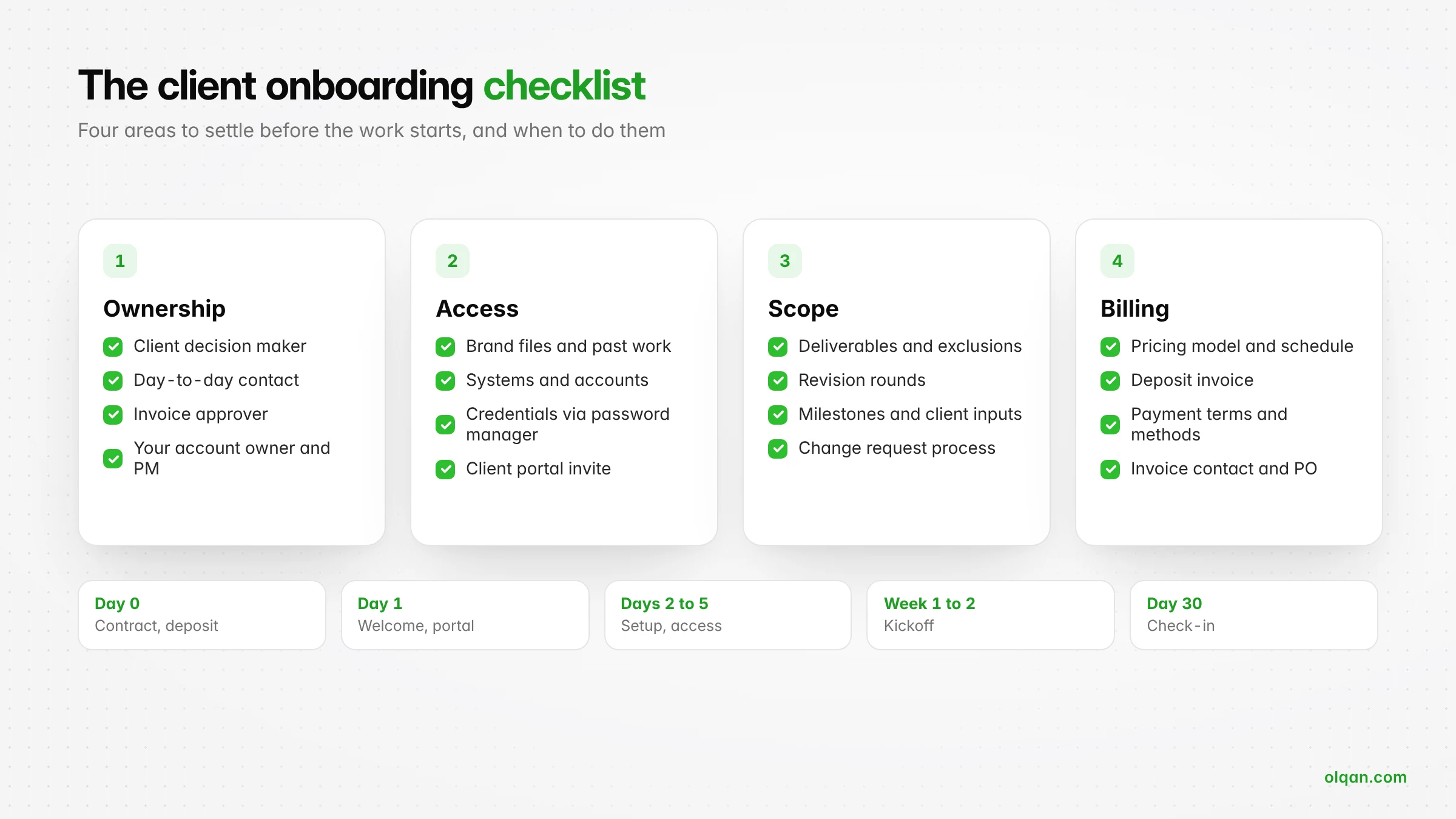
2. Ownership: who does what
- Client decision maker who approves deliverables and change requests.
- Client day-to-day contact for questions and feedback.
- Client contact who receives and approves invoices.
- Your account owner, project manager and the team members on the account.
- Escalation path on both sides if something goes wrong.
- One point of contact on each side, so everyone knows their role and roles and responsibilities are clear.
3. Access: what your team needs
- Brand guidelines, existing assets, past reports and research.
- Access to the client’s systems: website, analytics, ad accounts, CRM, file storage.
- Credentials shared through a password manager or the platform’s own user invites, never by email.
- Client access to your side: client portal, shared folders and project updates.
- A record of who has access to what, so it can be removed when the engagement ends.
4. Scope expectations: what is and is not included
- Deliverables with quantities, and what is explicitly out of scope.
- Number of revision rounds per deliverable.
- Timeline with milestones and the dates the client must provide input.
- Acceptance criteria: how each deliverable is approved.
- The change request process and what extra work costs. See our guide on how to manage scope creep.
5. Billing expectations: how and when the client pays
- Pricing model: fixed fee, time and materials, or retainer.
- Billing schedule: deposit, milestones or monthly, with dates and amounts.
- Payment terms, accepted payment methods, currency and tax details.
- Purchase order number, if the client’s finance team requires one.
- Who receives invoices and where to send them.
- What happens if a payment is late.
6. Communication: how you will work together
- Main channels for questions, feedback and approvals.
- Meeting cadence: weekly status call, monthly review.
- Expected response times on both sides.
- Format and frequency of status reports.
7. Kickoff meeting
- Introductions and roles on both sides.
- Goals and success measures, in the client’s words.
- Walk-through of scope, timeline, change process and billing schedule.
- Open questions and actions for the first two weeks.
8. First 30 days
- First deliverable or quick win delivered.
- Check-in call after two weeks: is the engagement matching expectations?
- First invoice paid on time.
- Short feedback request about the onboarding experience.
Client onboarding timeline
| When | What happens | Owner |
|---|---|---|
| Day 0 | Contract signed, client record created, deposit invoice issued | Account owner, finance |
| Day 1 | Welcome email and intake questionnaire sent, client portal access granted | Account owner |
| Days 2 to 4 | Internal handoff, project set up with budget, milestones and team | Project manager |
| Days 3 to 5 | Access and assets collected, questionnaire returned | Project manager, client contact |
| Week 1 or 2 | Kickoff meeting | Project manager |
| Week 2 | First deliverable or plan delivered, check-in call | Project team |
| Day 30 | Onboarding review and feedback, first invoice paid | Account owner |

Client onboarding template (free to copy)
Use these as a free template for new client onboarding. Adapt the wording to your agency or firm, but keep the structure: it gives clients the information you need from them and tells them what happens next.
Welcome email
Subject: Welcome to [your company]: next steps for [project name]
Hi [name], thank you for choosing us. Here is what happens next:
- Your project manager is [name], your main contact for day-to-day questions.
- Please complete the short intake questionnaire by [date]. It takes about 15 minutes.
- You will receive an invite to our client portal, where you can follow progress, approve deliverables and pay invoices.
- Our kickoff meeting is planned for [date]. We will walk through the scope, timeline and how changes are handled.
- Your first invoice, for [deposit or first milestone], is attached. Payment terms are [terms].
We are looking forward to working with you.
Intake questionnaire questions
- What does success look like for this project in six months?
- Who needs to approve deliverables, and who else should be kept informed?
- What has worked or not worked with previous agencies or consultants?
- Which systems and accounts will we need access to, and who can grant it?
- Are there dates we should know about: launches, events, holidays, budget cycles?
- Who receives invoices, and do you need a purchase order number on them?
Worked example: onboarding a consultancy client
An illustrative example, not a real client. A consultancy signs a three-month operations review for $18,000, billed as a 50% deposit and two milestone payments of $4,500.
- Day 0: the signed proposal is stored with the client record, and the $9,000 deposit invoice goes out with 14-day terms.
- Day 1: the welcome email names the engagement lead, attaches the intake questionnaire and confirms the kickoff date. The client’s COO is the decision maker; the finance manager receives invoices.
- Days 2 to 4: the project is set up with three milestones (current-state review, recommendations, implementation plan), a 90-hour budget and the team.
- Day 5: the client returns the questionnaire and grants access to their reporting tools.
- Week 2: kickoff meeting confirms the interview schedule, two revision rounds on the recommendations report, and the change request rate for extra workshops.
- Day 30: the deposit is paid, the current-state review is delivered, and the check-in call confirms the project is on track.
Nothing in this example is complicated. The client feels confident because every next step is clear. The difference is that every item has an owner and a date, so nothing waits for someone to remember it.
Client onboarding for agencies, consultancies and accounting firms
The checklist above works for most service businesses, with a few differences by type:
- Agencies: brand assets, ad and analytics access, and approval rules for creative work matter most. A client onboarding checklist for agencies should put revision rounds and approvers up front.
- Consultancies: stakeholder interviews, data requests and confidentiality agreements usually come first. Agree who can share which client information.
- Accounting firms: an accountant onboarding a bookkeeping client typically needs a signed engagement letter, prior-period records, bank and software access, and identity checks required in their jurisdiction.
Client onboarding best practices
- Set clear expectations in writing. Scope of work, timeline, billing and change process, confirmed at kickoff.
- Keep one line of communication. A single point of contact on each side prevents mixed messages.
- Make onboarding consistent. Every client goes through the same steps, whoever runs the account.
- Front-load the questions. A short questionnaire up front simplifies the process for both sides.
- Ask for client feedback. A two-question survey at day 30 shows what to improve in your onboarding strategy.
- Treat onboarding as customer success. The goal is not paperwork. It is a new client who sees value quickly and stays.
Common client onboarding mistakes
- Starting work before the contract and deposit are in place. It is much harder to ask for both once work has begun.
- Unclear ownership. Feedback from five people, with no one able to approve, slows every deliverable.
- Collecting access by email. It is slow, insecure and hard to audit.
- Explaining billing only on the invoice. Payment terms and the invoice contact belong in the kickoff, not a surprise later.
- No check-in after the first weeks. Small misunderstandings grow into dissatisfied clients.
- A different onboarding every time. Without a template, the client experience depends on who runs the account.
How to automate client onboarding
- Use templates for the welcome email, proposal, contract and project setup to streamline every new client.
- Assign tasks automatically to the account owner, project manager and finance when a client signs, so a smooth onboarding process does not depend on memory.
- Use a form for the intake questionnaire, so answers arrive in a consistent format.
- Use a client portal for approvals, documents and payments instead of long email threads.
- Create the deposit invoice from the agreement so billing starts the day the client signs.
- Keep client, project and billing records connected, so the account owner, project manager and finance see the same information. See what to look for in project management software with invoicing.
How Olqan supports client onboarding
Olqan is a business operating system that helps growing service businesses, including agencies and consulting firms, grow profitably. Onboarding a client happens in the same system you use to deliver and bill the work:
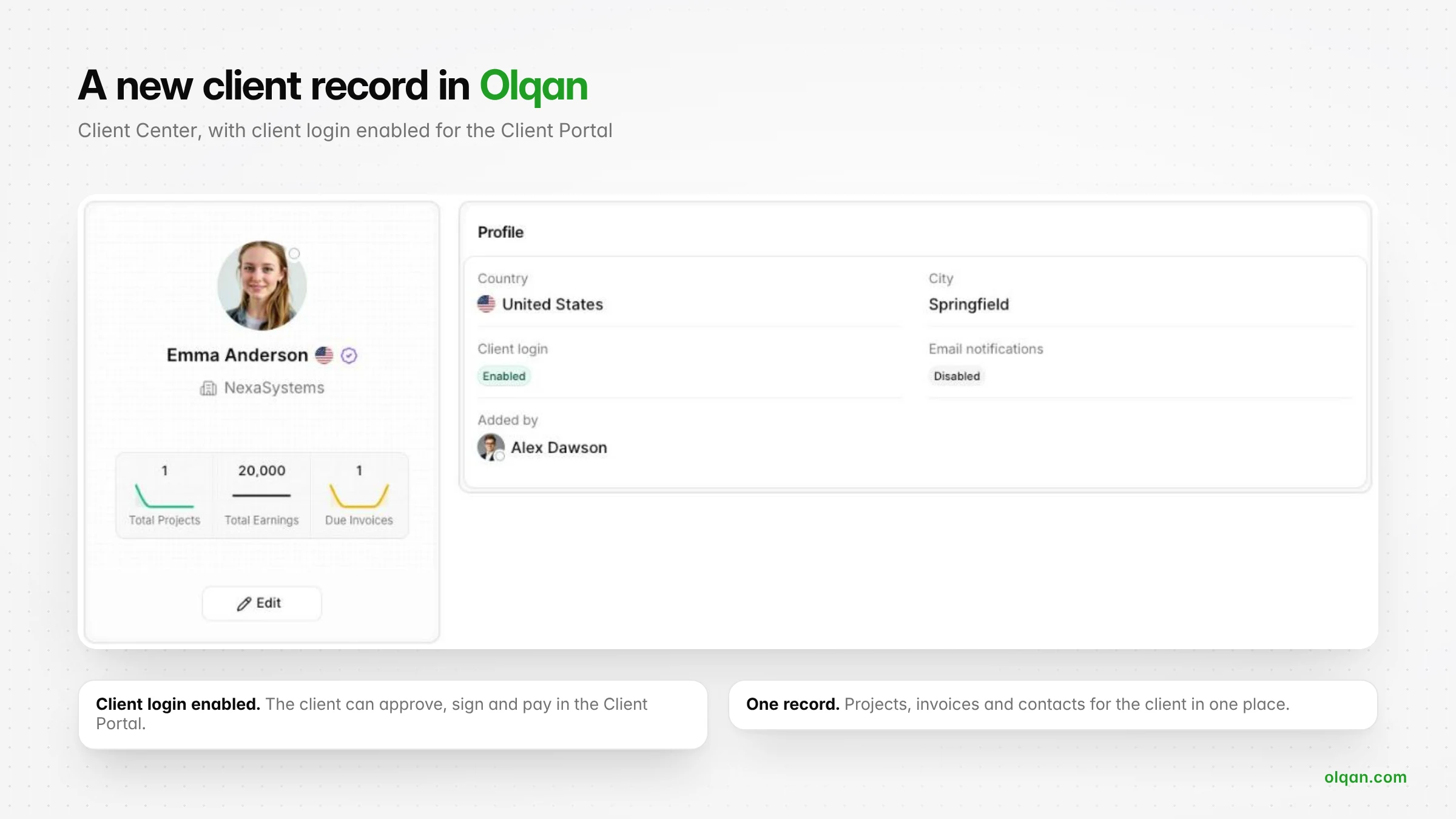
- Client Center: one record per client with company details, projects, invoices and client login access.
- Contracts, proposals and estimates: clients can review and e-sign them.
- Client Portal: clients approve, sign and pay in one place.
- Forms: build intake forms for new clients.
- Projects and invoicing: set up the project with milestones and budget, and invoice deposits, milestones or retainers. Online payments go through payment gateways such as Stripe, connected from Olqan’s marketplace.
Olqan offers a free Solo plan, and paid plans start at $12 per user per month billed yearly, with a 14-day trial and no credit card required (see pricing). To see client onboarding set up for your own business, book a demo.
Frequently asked questions
What should a client onboarding checklist include?
Signed agreement, client contacts and roles, access to systems and assets, scope and change process, billing terms and invoice contact, communication plan, kickoff meeting and a 30-day check-in.
How long should client onboarding take?
For most agencies and consultancies, one to two weeks from signed contract to kickoff, with a check-in at day 30. Larger engagements with many stakeholders can take longer.
Who should own client onboarding?
One person, usually the account owner or project manager, owns the checklist. Finance owns billing setup, and the project manager owns access and kickoff.
What is the difference between client onboarding and a kickoff meeting?
Client onboarding is the whole process of setting up a new client. The kickoff meeting is one step in it: the first working session where goals, scope and timeline are confirmed with the client.
What documents are needed for onboarding new clients?
Usually a signed contract or engagement letter, the scope of work, billing and tax details, any NDA, and the intake questionnaire. Regulated firms, such as accountants, may also need identity and compliance documents.
What are the 5 C’s of onboarding?
The 5 C’s (compliance, clarification, culture, connection and check back) come from employee onboarding, but they translate well to clients: contracts and terms, clear scope, ways of working, relationships with the team, and a follow-up after the first weeks.
Should you invoice before the project starts?
For many service businesses, yes. A deposit or first milestone invoice issued at signing confirms commitment and protects cash flow. Whatever you choose, agree it in the contract and explain it during onboarding.
Conclusion
Client onboarding is where a new client relationship either gets a clear structure or a slow, confusing start. Comprehensive client onboarding does not need to be complicated, and welcoming new clients well is one of the cheapest ways to build a strong reputation with new customers. Use one checklist for every client, give each item an owner, cover ownership, access, scope and billing before the work begins, and check in after the first weeks. The result is faster starts, fewer disputes and first invoices that are paid on time.