
To manage scope creep on a fixed-fee project, you need two things: a scope that is written down precisely enough to tell what is extra, and a change control process the client agreed to before work started. When a new request arrives, you log it, assess its impact on hours, cost and timeline, and either absorb it on purpose, swap it for something in scope, or price it as a change request that the client approves in writing before the work begins.
This guide covers what scope creep is, why it hurts fixed-fee work more than any other pricing model, how to spot it early, and a step-by-step change control process with real change request examples you can adapt for your agency or consultancy.
What is scope creep?
Scope creep is the gradual, uncontrolled expansion of a project’s scope after the project begins, without matching changes to the budget, timeline or resources. It is also called requirement creep or feature creep. The Project Management Institute (PMI) describes it in similar terms: scope that grows without control.
Scope creep rarely arrives as one big request. It is usually a series of small ones: one more page, one more revision round, one more stakeholder who wants a say. Each looks reasonable on its own. Together they can add weeks of work to a project that was priced for less.
Not every change is scope creep. A change becomes scope creep when it is added without being assessed, priced and approved. A well-managed scope change, with its cost and timeline agreed, is simply a change.
Why scope creep hurts fixed-fee projects most
On time and materials work, extra hours are billable. On a fixed-fee project, every unplanned hour comes straight out of your margin. Here is the effect on one engagement (illustrative figures):
| As planned | With 15% scope creep | |
|---|---|---|
| Fixed fee | $40,000 | $40,000 |
| Hours | 300 | 345 |
| Delivery cost at $80 per hour | $24,000 | $27,600 |
| Project margin | $16,000 (40%) | $12,400 (31%) |
Forty-five extra hours, spread across a few weeks, cost $3,600 and nine points of margin. Scope creep also pushes deadlines, ties up people booked for other clients, and frustrates the project team. For more on how margin is calculated, see our guide on how to calculate agency project profitability.
What causes scope creep
- A vague scope statement. “Website redesign” or “brand refresh” without deliverables, quantities and exclusions invites interpretation.
- No agreed change control process. If the contract does not say how changes are handled, every request becomes a negotiation.
- Too many stakeholders. New stakeholders join mid-project with their own project requirements.
- Unlimited revisions. Without a set number of revision rounds, feedback never ends.
- Gold plating. The project team adds features nobody asked for, often with good intentions.
- Weak handoff from sales. Delivery does not know exactly what was sold. Our sales-to-project handoff checklist covers how to fix that.
- Saying yes to keep the client happy. Small favors become expectations.
How to spot scope creep early
- Hours logged are ahead of the work completed, even though nobody approved extra work.
- The same deliverable is on its third or fourth round of feedback.
- New requests start with “while you’re at it” or “quick one”.
- Tasks appear in the project plan that do not map to any deliverable in the scope.
- Stakeholders the project team has never met start sending feedback.
The most reliable signal is budget versus actual. If you track hours against the project budget weekly, scope creep shows up as a variance long before the end of the project. Our guide to budget vs actual project costs shows how.
How to prevent scope creep before the project begins
Most scope creep is prevented before the first task starts, by defining the project scope and the rules for changing it.
- Write a clear scope statement. The project scope should list each deliverable with quantities: five page templates, not “website pages”.
- State what is out of scope. Exclusions are as important as inclusions.
- Set revision rounds. Two rounds per deliverable, for example, with a price for extra rounds.
- Define acceptance criteria. How each deliverable is signed off, and by whom.
- Put the change control process in the contract. Explain how changes are requested, priced, approved and billed.
- Name one decision maker on the client side. Feedback from other stakeholders goes through them.
- Walk through scope at the kickoff meeting. Confirm deliverables, exclusions and the change process with the client before work starts.
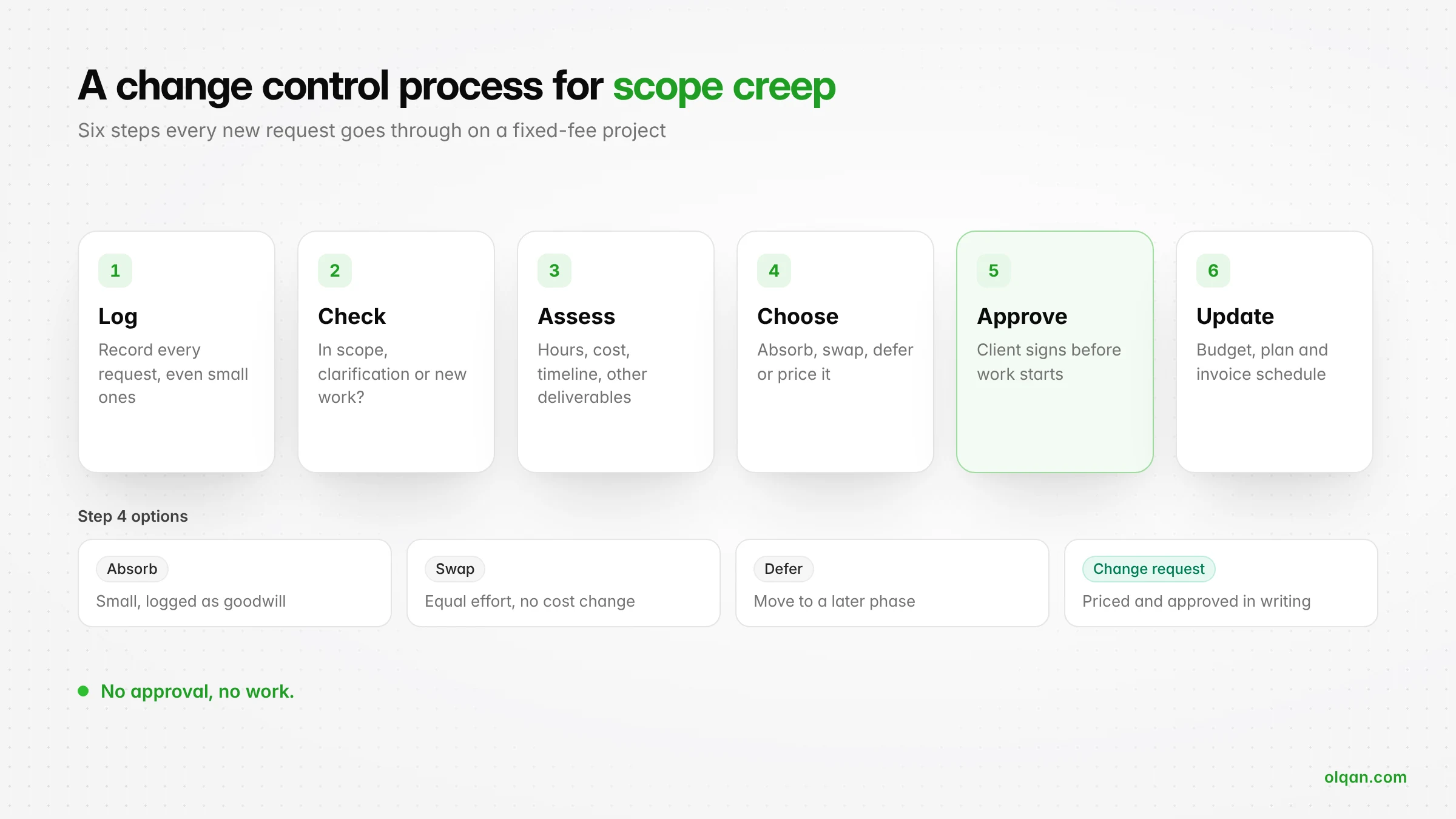
How to manage scope creep once it starts: a change control process
- Log every request. Even small ones. A change log shows patterns and protects you in later conversations.
- Check it against the scope. Is it within scope, a clarification, or new work?
- Assess the impact. Estimate hours, cost, timeline and any effect on other deliverables.
- Choose an option. Absorb it deliberately, swap it for something of equal effort, defer it to a later phase, or price it as a change request.
- Get written approval. The client approves the change request, ideally with an e-signature, before the work starts.
- Update the plan, budget and billing. Add the hours to the project budget, adjust the timeline and schedule the invoice.
The project manager owns this process, but the whole project team needs to know it. The rule that makes this work: no approval, no work. If the client needs the work urgently, approval can be quick, but it still happens first.
Change request examples
Four examples from a fixed-fee website project ($40,000, 300 hours). Figures are illustrative.
Example 1: new deliverable, priced
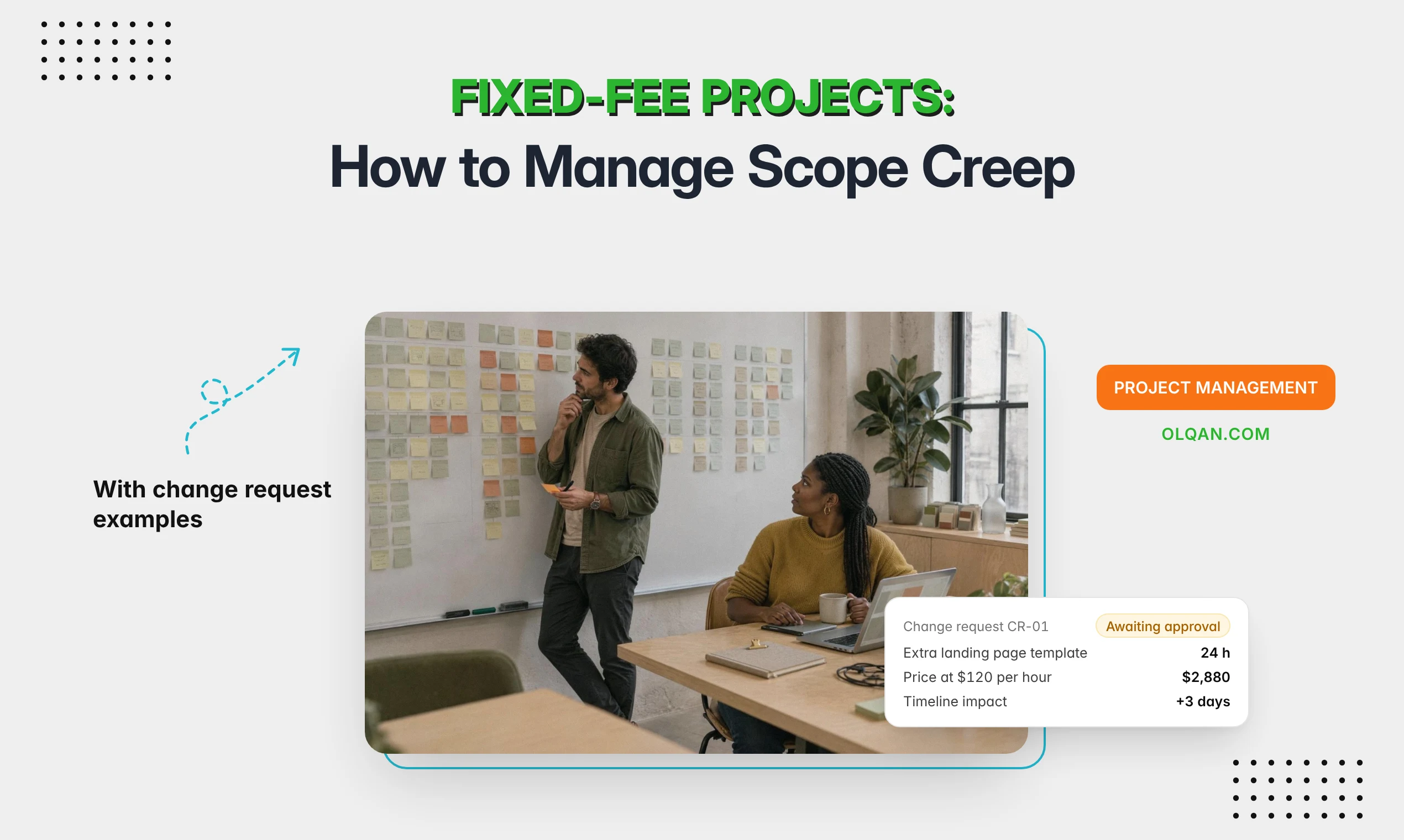
Request: the client asks for an additional landing page template for a campaign. Assessment: 24 hours, adds three working days to the build phase. Change request: 24 hours at $120 = $2,880, approved in writing before design starts, invoiced with the next milestone.
Example 2: extra revision round
Request: after two included rounds, the client’s new marketing director wants another round on the homepage design. Assessment: 10 hours. Change request: one additional revision round at $1,200, as set out in the contract.
Example 3: swap at no extra cost
Request: the client wants a blog section instead of the planned case study section. Assessment: similar effort, no change to the timeline. Change request: a zero-cost swap, documented and signed so both sides agree what was exchanged.
Example 4: small request, absorbed on purpose
Request: a two-hour copy update on a page already approved. Decision: absorb it as goodwill, but log it and tell the client it was done as a one-off. Recorded goodwill is a choice. Unrecorded goodwill becomes the new normal.
Change request template
| Field | What to include |
|---|---|
| Change request number | CR-01, CR-02 and so on, per project |
| Requested by and date | Name of the client stakeholder and the date of the request |
| Description | What is being added, removed or changed |
| Reason | Why the client needs it |
| Impact on scope | Which deliverables change |
| Impact on hours and cost | Estimated hours, rate and total price |
| Impact on timeline | New dates for affected milestones |
| Billing | When and how the change will be invoiced |
| Approval | Client signature and date, plus internal approver |
Approval steps that keep everyone aligned
- Project manager assesses the request and prepares the change request.
- Account lead or partner checks the price and the relationship context.
- Client decision maker approves in writing or by e-signature.
- Project team is told what changed, and only then starts the work.
- Finance adds the approved amount to the invoice schedule.
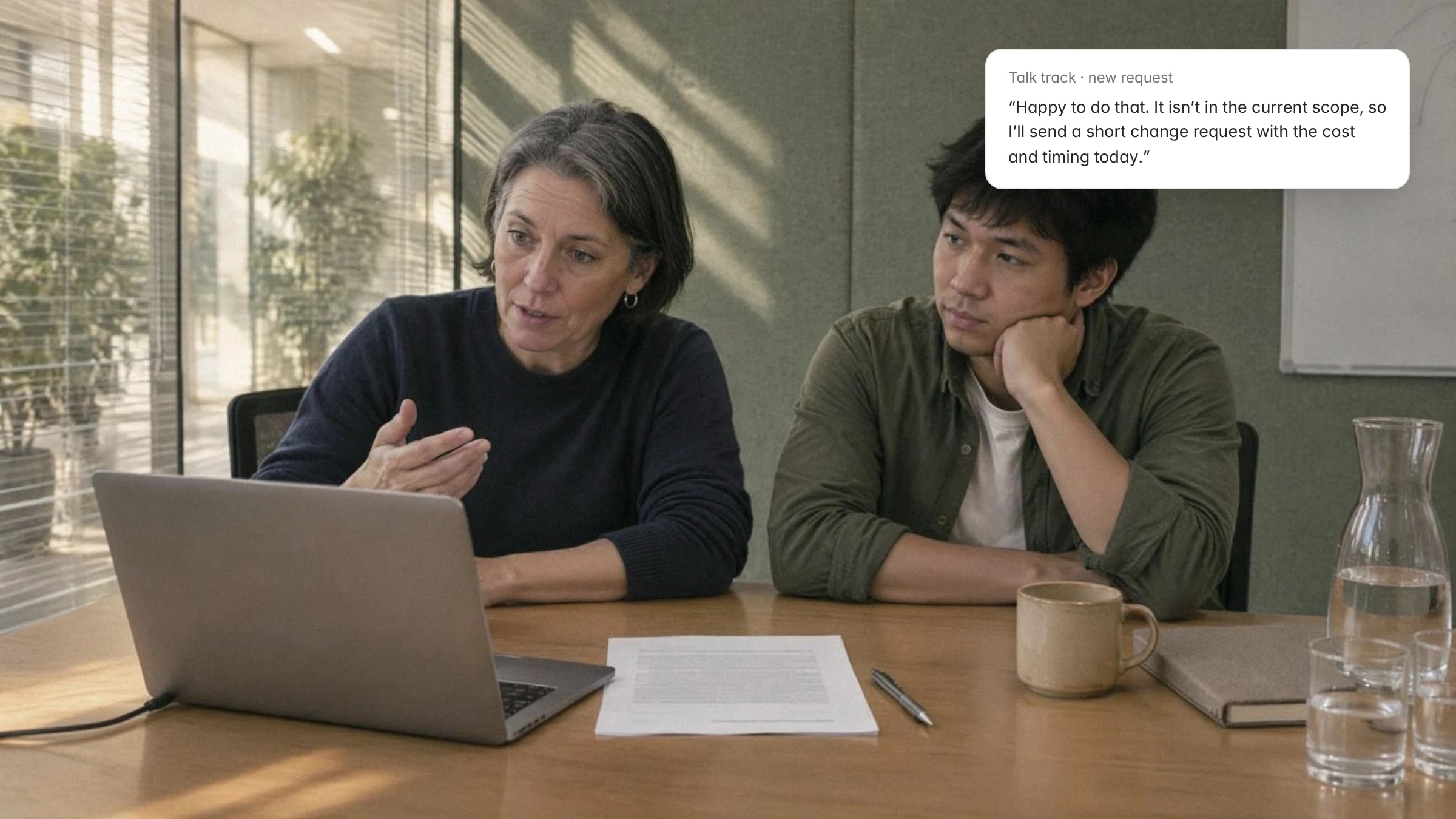
How to talk to clients about scope
Most clients do not see their requests as scope creep. They see a small favor. Keep the conversation neutral and factual:
- “Happy to do that. It isn’t in the current scope, so I’ll send a short change request with the cost and timing today.”
- “We can add that if we swap it for the case study section, which keeps the budget and timeline the same.”
- “That would push launch back by about a week. Do you want us to price it as a phase two item instead?”
Clear, quick change requests manage expectations better than a reluctant yes followed by a missed deadline.
Scope creep in agile projects
Agile projects expect requirements to change, but they still have boundaries. In fixed-fee agile work, the fee usually buys a fixed team for a fixed number of sprints. New items join the backlog and replace lower-priority items rather than adding to the total. Scope management in agile means managing priorities, not saying yes to everything.
Common mistakes when you manage scope creep
- Starting the work before approval. Once delivered, extra work is very hard to bill.
- Pricing changes at a discount by default. Use the same rates as the original estimate.
- Not updating the project budget. Approved changes must be added to the budget, or budget versus actual becomes meaningless.
- Forgetting to invoice approved changes. An approved change request that never reaches an invoice is unbilled work.
- Blaming the client. Most scope creep starts with a vague scope. Fix the template, not just the project.
How Olqan helps you control scope on fixed-fee projects
Olqan is a business operating system that helps growing service businesses, including agencies and consulting firms, grow profitably. The scope, the hours and the billing for a project sit in one place:
- Estimates for change requests: create an estimate linked to the client and project, with the hours, price and description of the change.
- Client approval: clients can approve and e-sign proposals, estimates and contracts, including through the Client Portal.
- Project budgets: hours allocated versus hours logged on every project, so unapproved extra work shows up early.
- Invoicing: turn an approved estimate into an invoice, or bill changes with the next milestone.
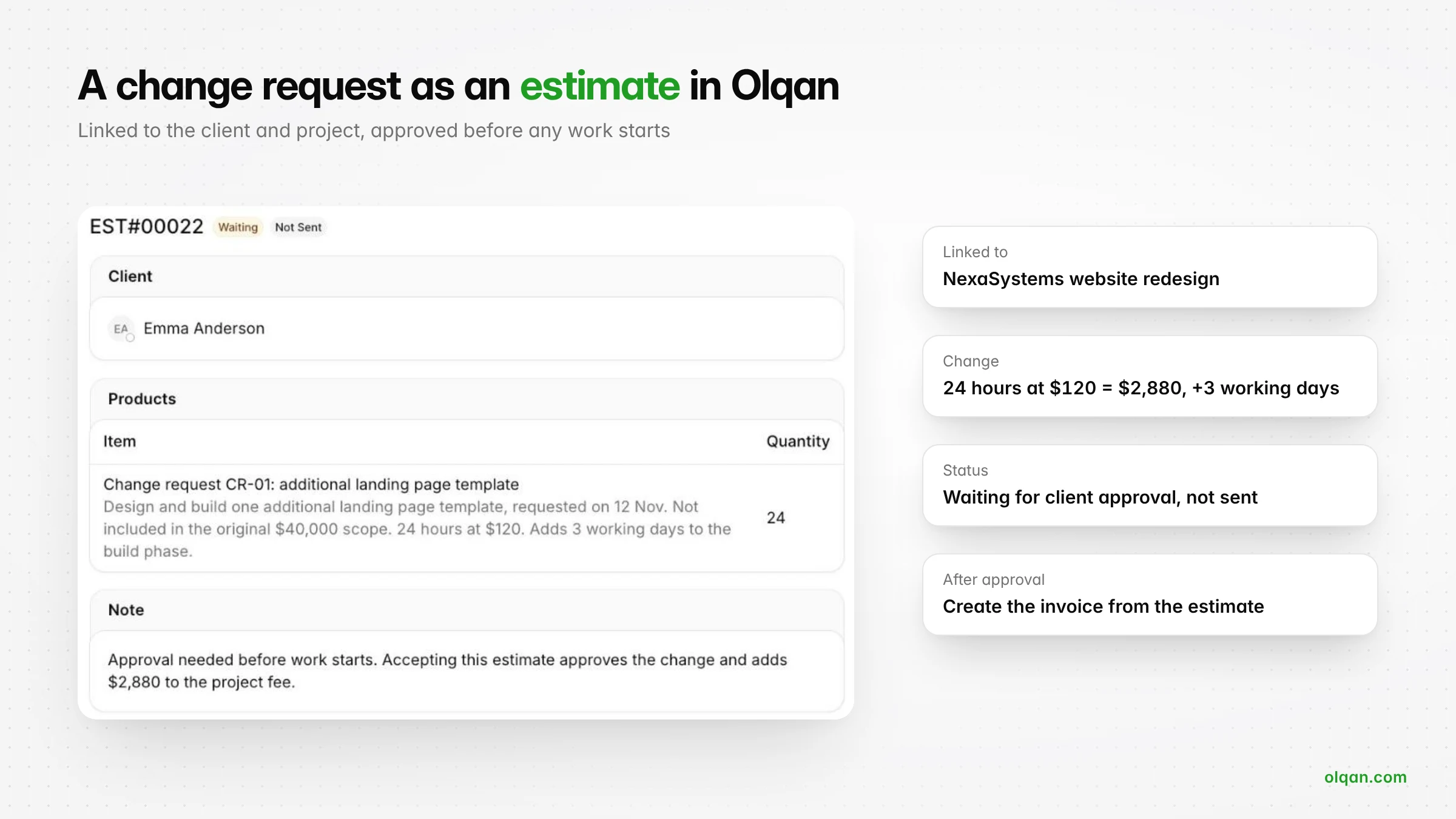
Olqan offers a free Solo plan, and paid plans start at $12 per user per month billed yearly, with a 14-day trial and no credit card required (see pricing). To see the change request flow on your own projects, book a demo.
Frequently asked questions
What is scope creep in project management?
Scope creep is the uncontrolled growth of a project’s scope after it starts, without matching changes to budget, timeline or resources.
What is another name for scope creep?
Requirement creep, feature creep or kitchen-sink syndrome. In software projects, feature creep is the most common term.
Is scope creep always bad?
Uncontrolled scope creep is. But a scope change is not bad in itself. Clients learn during a project, and a well-priced change request can improve the result and increase revenue. The problem is change without assessment, pricing and approval.
What is the difference between a change request and a change order?
A change request is the proposal to change scope. A change order is the approved, signed version that authorizes the work and the extra cost. Many agencies use one document for both.
How do you say no to scope creep without upsetting the client?
Do not say no. Say yes, at a price and on a timeline, or offer a swap. Clients usually accept a clear change request when it arrives quickly and explains the impact.
Conclusion
Scope creep is not a client problem or a team problem. It is a process problem, and every project manager can fix it. Write a precise scope with exclusions and revision rounds, agree the change control process in the contract, and run every request through the same steps: log, assess, choose, approve, update. On a fixed-fee project, that discipline is the difference between the margin you priced and the margin you keep.