
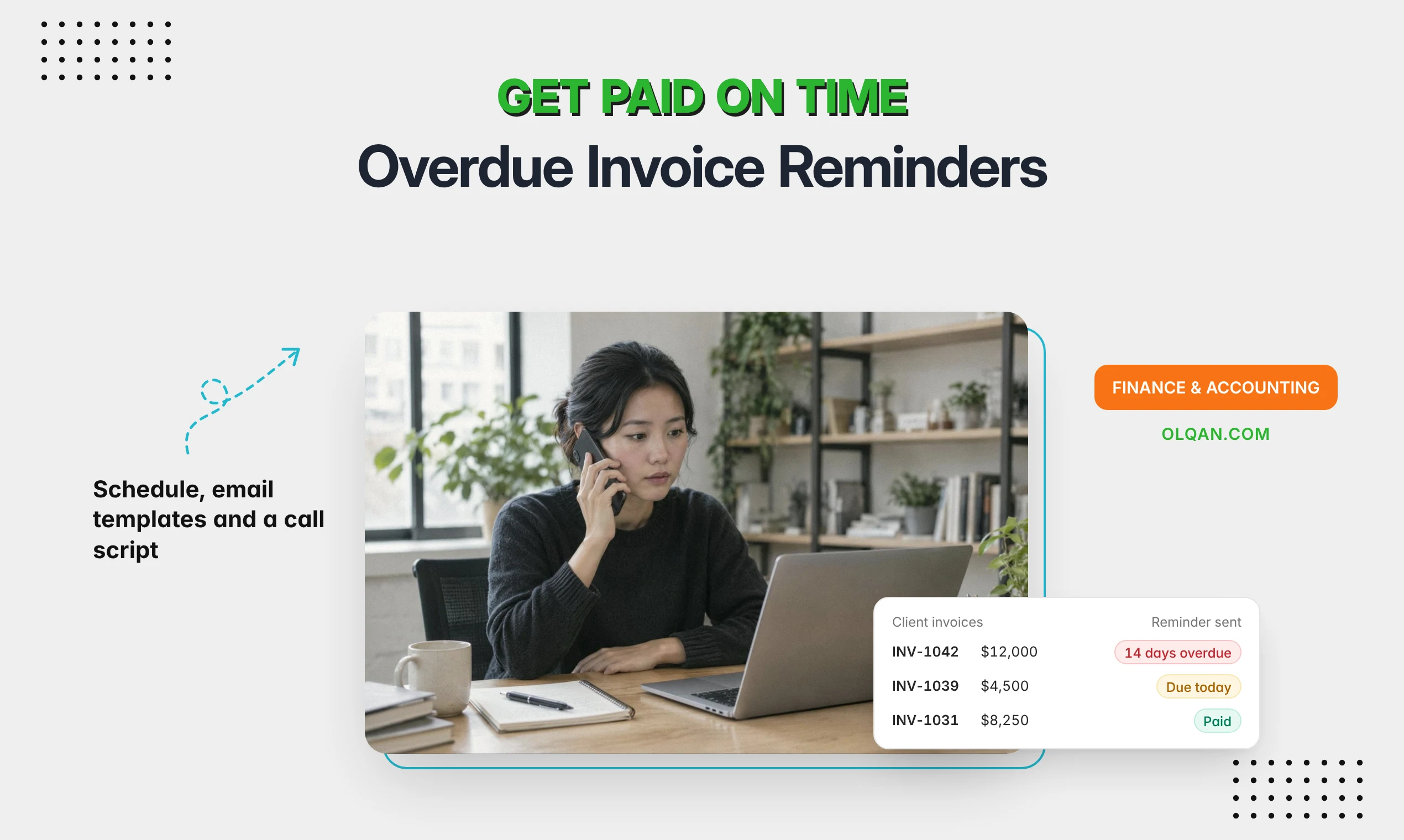
To follow up on an overdue invoice, send a friendly reminder a few days before the due date, a short note on the due date, then follow up at 7, 14 and 30 days overdue with a firmer tone each time. Every reminder should repeat the invoice number, amount, due date and a way to pay. If emails go unanswered, pick up the phone, offer a payment plan if it helps, and send a final notice before you escalate. The key is a clear schedule you follow every time, so no unpaid invoice slips through.
This guide is written for agency owners, consultants and small business owners who want to get paid faster without damaging client relationships. It gives you an overdue invoice reminder schedule, eight payment reminder email templates you can copy, a phone script, a worked example from an agency, and the steps that prevent late payment in the first place.
What is an overdue invoice?
An overdue invoice is an invoice that has not been paid by its payment due date. If your payment terms are net 14 and the invoice is dated 1 March, it is due on 15 March and overdue from 16 March. An overdue invoice is also called a past due invoice or a late invoice.
For a service business, every overdue invoice is cash you have already earned but cannot use. Agencies and consultancies pay salaries and contractors every month, whether clients pay on time or not, so overdue invoices hit cash flow first.
Why client invoices go overdue
Most late payment is not deliberate. Before you send a reminder, it helps to know the usual causes:
- The invoice went to the wrong person. It was sent to the project contact, not the person who approves and pays invoices.
- Missing details. No purchase order number, wrong billing entity or missing tax details, so the client’s finance team cannot process it.
- A question about the work. The client is unhappy with a deliverable or unsure what the invoice covers, and holds payment until it is resolved.
- It was simply forgotten. The invoice is sitting in an inbox. A polite reminder usually fixes this.
- The client has a cash flow problem. They want to pay but cannot pay the full amount right now.
- Payment is hard. Bank transfer only, no payment link, or no clear payment method on the invoice.
Your reminders should solve the most likely cause, not just ask again.
Before you send a reminder: a quick check
Spend two minutes checking these before sending a reminder. It avoids awkward emails to a client who has already paid.
- Has the payment arrived but not been recorded? Check your bank and your invoicing software.
- Was the invoice sent, and to the right invoice contact?
- Does the invoice have the purchase order number, billing details and payment terms the client needs?
- Is there an open question or dispute about the work?
- Do you have a contract that sets payment terms, late fees or the right to pause work?
Overdue invoice reminder schedule
A fixed schedule makes following up on overdue invoices routine instead of personal. Here is a schedule that works for most agencies, consultancies and other small businesses on net 14 or net 30 terms.
| When | Reminder | Channel | Tone |
|---|---|---|---|
| 3 days before due date | Upcoming payment reminder | Friendly | |
| Due date | Invoice is due today | Friendly | |
| 7 days overdue | First overdue reminder | Polite, direct | |
| 14 days overdue | Second reminder, ask for a payment date | Email, then a phone call | Firm |
| 30 days overdue | Escalation to a senior contact, late fee if in your terms | Email and phone | Formal |
| 45 days overdue | Final notice with a deadline | Email or letter | Formal, final |
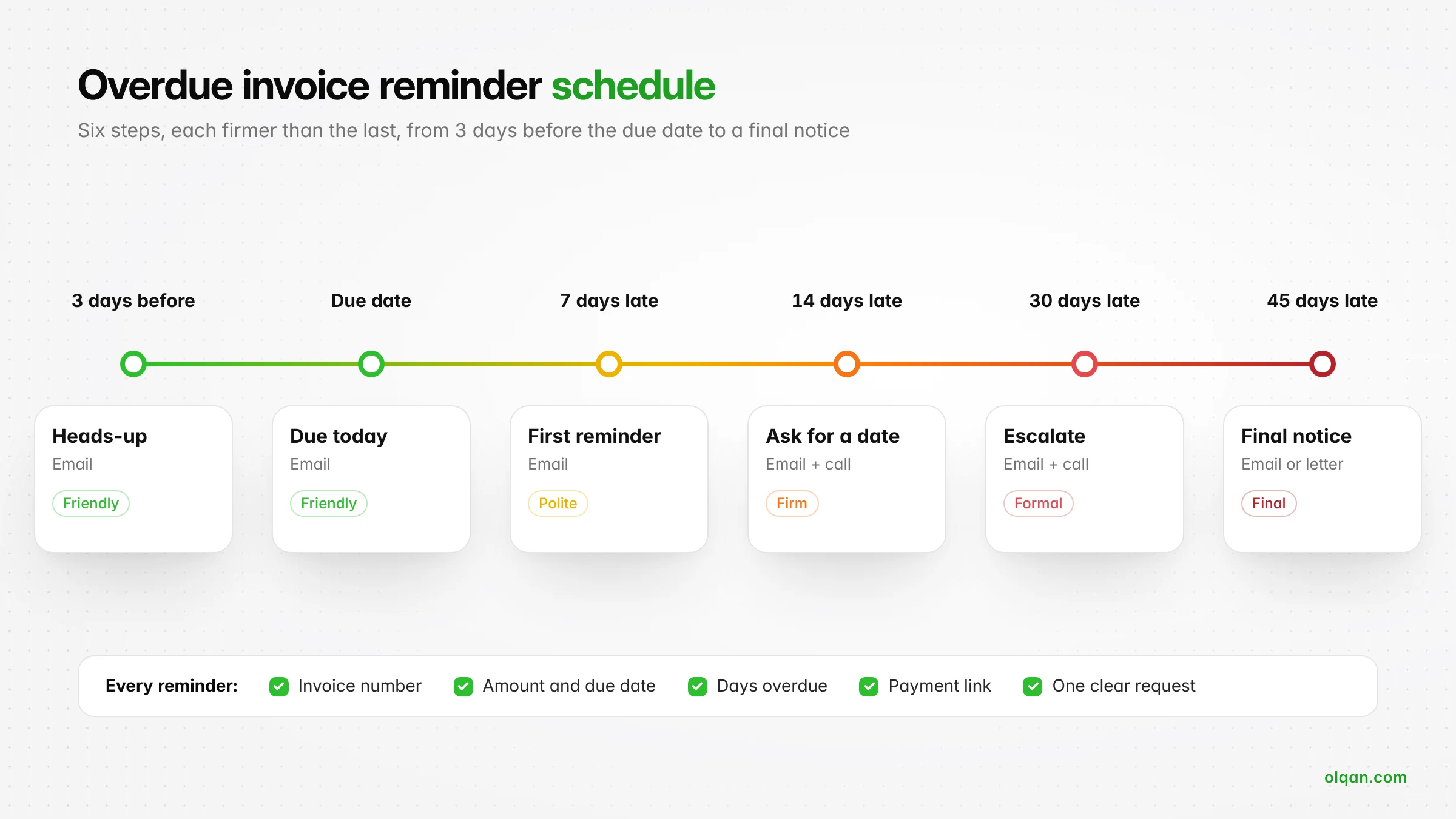
The first email is a gentle nudge, not a demand. Later reminders can help most when they also remove whatever is blocking payment. Adjust the timing to your payment terms and the size of the client. For a large invoice, call earlier. For a long-standing client who has always paid on time, the first overdue reminder can be even softer.
What to include in every payment reminder email
- A clear subject line with the invoice number and the word reminder or overdue.
- Invoice number, amount and due date, so the client can find it in seconds.
- Number of days overdue, stated plainly, from the first overdue reminder onward.
- A payment link or payment details, so they can pay the invoice straight from the email.
- The invoice attached, or a link to it. Never make the client search for it.
- One clear request: pay now, or reply with an expected payment date.
- Your contact details for questions about the invoice.
Keep each email reminder short. A reminder that takes ten seconds to read gets paid faster than one that takes two minutes. The goal is to write a professional message that lets the client know exactly what is owed and how to make a payment.
8 overdue invoice reminder email templates
Copy these payment reminder email templates and replace the invoice details in brackets. Each email template matches a step in the schedule above, and each reminder template is short enough to customize in a minute.
1. Friendly reminder before the due date
Subject: Upcoming payment: invoice [number] due [date]
Hi [name],
A quick heads-up that invoice [number] for [amount] is due next week, on [date], so the payment is due before your next payment run. You can pay it here: [payment link]. The invoice is attached for your records.
Thanks, and let me know if you need anything from us to process it.
[Your name]
2. Invoice due today
Subject: Invoice [number] is due today
Hi [name],
Just a reminder that invoice [number] for [amount] is due today. If it is already on its way, thank you. If not, you can pay by [payment method] or here: [payment link].
Best regards,
[Your name]
3. First overdue reminder (7 days late)
Subject: Reminder: invoice [number] is 7 days overdue
Hi [name],
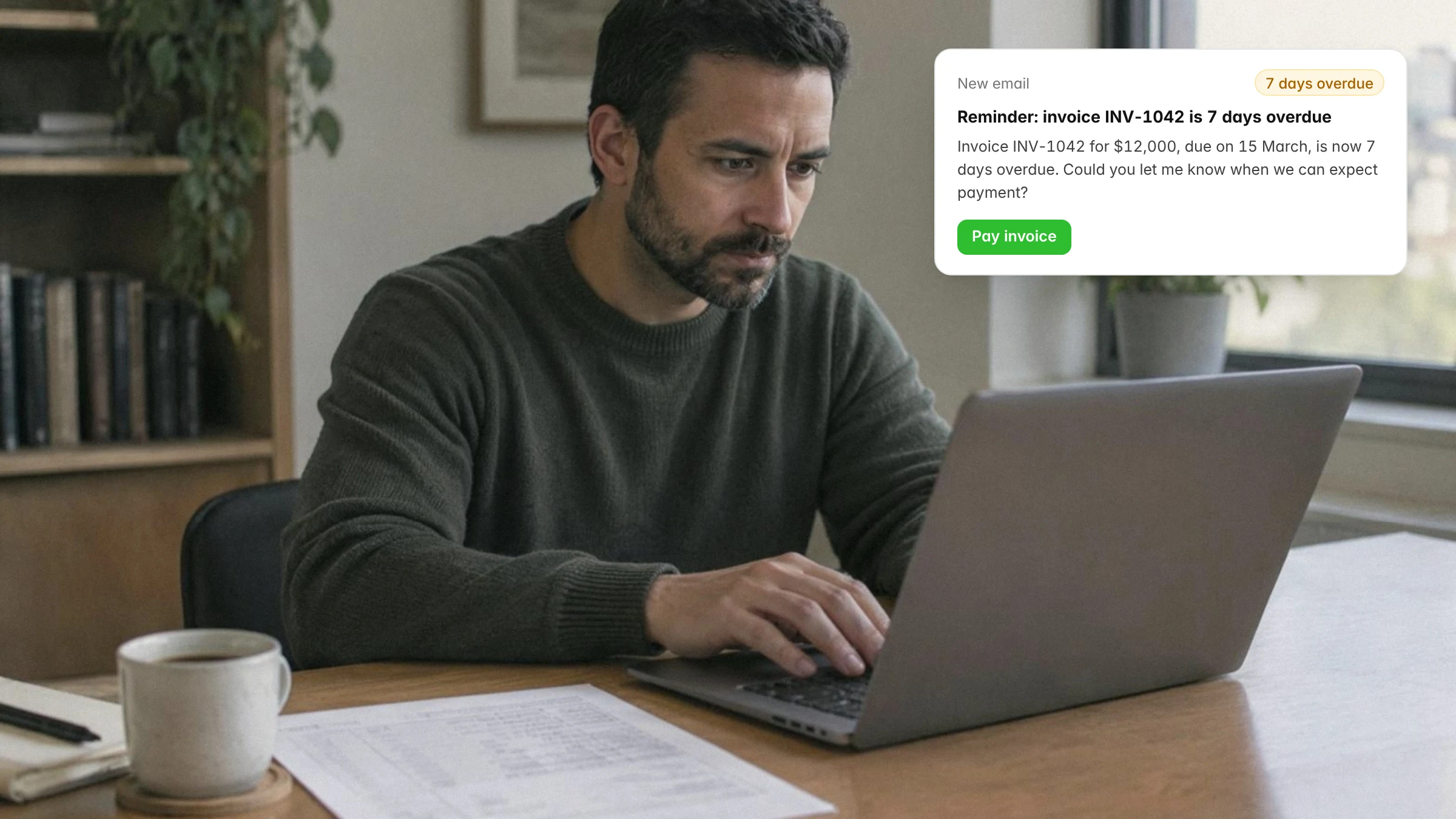
I hope all is well. Our records show that invoice [number] for [amount], due on [date], is now 7 days overdue. It may have slipped through, so I have attached it again.
Could you let me know when we can expect payment? You can pay online here: [payment link].
Thanks,
[Your name]
4. Second reminder (14 days late)
Subject: Second reminder: invoice [number], 14 days overdue
Hi [name],
I am following up on invoice [number] for [amount], which was due on [date] and is now two weeks late. We have not received payment or a reply to our earlier reminder.
Please arrange payment this week, or reply with a payment date. If something is holding it up, such as a missing purchase order or a question about the work, tell me and I will sort it out today.
Regards,
[Your name]
5. Escalation (30 days late)
Subject: Overdue payment: invoice [number], 30 days past due
Dear [name],
Invoice [number] for [amount] is now 30 days past due, and we have not been able to reach you about it. I am copying [senior contact or finance manager] so we can resolve it.
As set out in our agreement, a late fee of [amount or rate] applies to payments more than 30 days overdue. Please pay the outstanding invoice by [date] to avoid it: [payment link].
Regards,
[Your name]
Only mention a late fee if it is in your contract or payment terms.
6. Final notice (45 days late)
Subject: Final notice: invoice [number]
Dear [name],
This is our final reminder for invoice [number] for [amount], due on [date] and now 45 days overdue. Despite our previous emails and calls, the invoice remains unpaid.
Please pay in full by [date]. If we do not receive payment or hear from you by then, we will [pause work on the account / refer the debt to a collection agency / take the next steps set out in our terms].
Regards,
[Your name]
Only state a next step you are prepared to take, and check your contract and local rules first.
7. Payment plan offer
Subject: Payment plan for invoice [number]
Hi [name],
Thanks for letting me know about the delay. To help, we can split invoice [number] for [amount] into [number] payments of [amount], on [dates]. If that works, reply to confirm and I will send the first payment link.
Best regards,
[Your name]
8. Thank you after payment
Subject: Payment received: invoice [number]
Hi [name], thank you, we have received payment for invoice [number]. Your receipt is attached. We appreciate it.
Phone call script
Call after the second reminder, or earlier for large invoices. Keep it short and helpful:
“Hi [name], it is [your name] from [company]. I am calling about invoice [number] for [amount], which was due on [date]. Is there anything holding it up on your side? … Great, can we agree on a payment date? I will send a confirmation email with the payment link now.”
Always follow up a call with a short email that confirms the agreed payment date.
Text message reminder
If your client prefers messages, a short text works for small amounts: “Hi [name], a friendly reminder that invoice [number] for [amount] was due on [date]. You can pay here: [payment link]. Thanks, [your name].”
Worked example: following up on an agency invoice
An illustrative example, not a real client. A digital agency invoices a $12,000 website milestone on 1 March with net 14 payment terms, so it is due on 15 March.
- 12 March: the friendly reminder goes out with the payment link.
- 15 March: due date reminder. No reply.
- 22 March (7 days overdue): first overdue reminder. The client replies that their finance team needs a purchase order number on the invoice.
- 23 March: the agency reissues the invoice with the PO number. The original due date stays, as agreed.
- 29 March (14 days overdue): second reminder and a call to the finance manager, who confirms payment on their next payment run, 5 April.
- 5 April: the invoice is paid. The agency sends a thank-you and adds “PO number required” to the client record, so the next invoice goes out right the first time.
The fix was not more reminders. It was finding what blocked payment and removing it. That is why the second reminder asks “is anything holding it up?”
What to do when a client ignores payment reminders
- Change the channel. If emails go unanswered, call. If the project contact is silent, contact the person who approves invoices.
- Ask for a date, not just payment. A commitment to a specific payment date is easier to get, and easier to follow up, than a vague promise.
- Offer a payment plan if the client has a cash flow problem. Partial payments now are better than full payment never.
- Apply the terms you agreed. If your contract allows a late fee or pausing work, apply it consistently and in writing.
- Escalate after the final notice. Options include a collection agency or a small claims process. Rules differ by country, so get local advice before you take this step.
Should you charge a late fee on an overdue invoice?
A late fee can encourage clients to pay on time, but only if it is agreed up front in your contract or payment terms and shown on the invoice. Adding a late fee the client never agreed to usually damages the relationship and may not be enforceable. In some countries, laws give businesses the right to charge interest on late business-to-business payments, such as late payment rules in the UK and the EU. Check what applies to you, as this is not legal advice.
Many service businesses use the late fee mainly as leverage: mention it in the 30-day reminder and waive it if the client pays by the new date.
Best practice for overdue invoice reminders
- Stay polite and factual. Assume a mistake until you know otherwise. You will probably work with this client again.
- Be consistent. Send reminders on the same schedule for every client, so it never feels personal.
- Make paying easy. A secure payment link in every reminder removes the most common excuse and makes it easy for clients to pay their invoice.
- Use one thread. Reply in the same email thread so the full history is in one place.
- Record every contact. Note dates, replies and promised payment dates against the invoice.
- Review overdue invoices weekly. A short weekly check is enough to catch late payments before they become a problem.
How to prevent overdue invoices
- Agree payment terms at the start. Payment terms, late fees in your terms and conditions, the invoice contact and purchase order needs belong in onboarding, so you get your client to agree before work starts. Our client onboarding checklist covers this.
- Take a deposit on fixed-fee projects, and invoice milestones as soon as they are approved.
- Invoice promptly. Work that sits unbilled delays cash as much as late payment. See how agencies can find unbilled client work.
- Accept online payments, so clients can pay by card or payment link in a minute.
- Automate invoice reminders, so the schedule runs without anyone having to remember it.
Automated reminder tools and templates that save time
Sending reminders by hand works for a handful of clients. As the number of invoices grows, nobody can remember to send every reminder, and it becomes the task that gets skipped. Automatic invoice reminders save time for the business owner and the finance team. Most invoicing software can automate the routine part:
- Track every invoice by status, so overdue invoices are visible on a dashboard instead of in a spreadsheet.
- Send payment reminder emails from your reminder templates, with the invoice and payment link included.
- Let clients pay online, and mark the invoice paid when the payment arrives.
- Keep phone calls, payment plans and final notices as human steps. Those are the conversations that need judgment.
If you are comparing tools, our guide to project management software with invoicing lists the questions to ask.
How Olqan helps you get paid on time
Olqan is a business operating system that helps growing service businesses, including agencies and consulting firms, grow profitably. Invoices are created from the same projects and agreements your team works on, so following up is part of the same workflow:
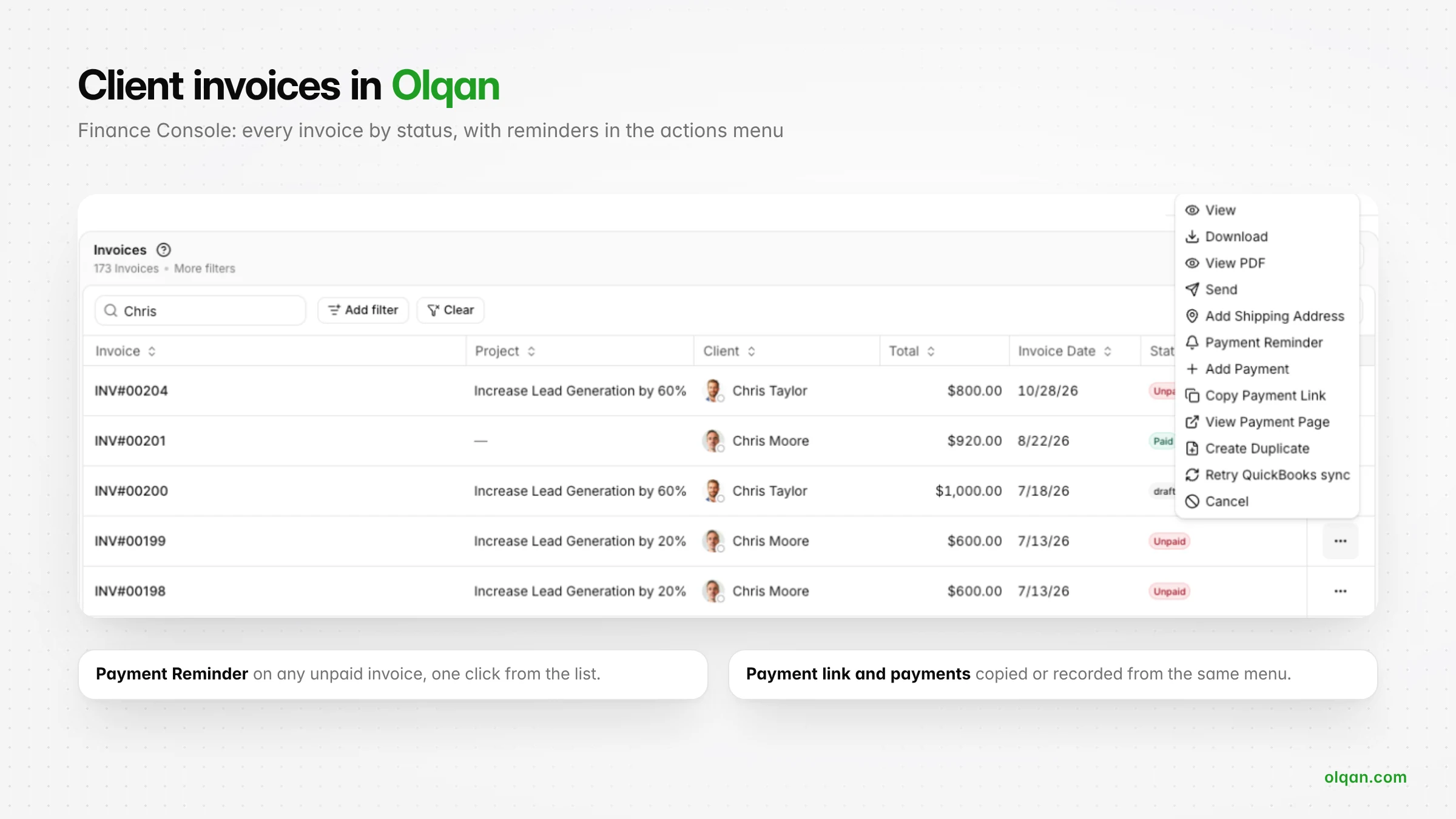
- Invoice status tracking: see every invoice by status in the Finance Console, from draft and unpaid to partly paid and paid.
- Payment reminders: send a payment reminder on any unpaid invoice straight from the invoice list, or copy the invoice’s payment link to share with the client.
- Online payments: clients pay through the Client Portal, with payment gateways such as Stripe, PayPal and Square connected from Olqan’s marketplace.
- Payment tracking: record card, bank transfer, payment link and cash payments, including partial payments, and reconcile them.
- Invoicing from projects: invoice time, milestones and retainers as soon as work is done, so less work sits unbilled.
Olqan offers a free Solo plan, and paid plans start at $12 per user per month billed yearly, with a 14-day trial and no credit card required (see pricing). To see it with your own clients and invoices, book a demo.
Frequently asked questions
How do you politely remind a client about an unpaid invoice?
Keep it short and factual: name the invoice number, amount and due date, attach the invoice, include a payment link, and ask when you can expect payment. Assume it was missed, not ignored. Template 3 above is a good starting point.
When should I send the first reminder for an overdue invoice?
Send a friendly reminder a few days before the due date, a short note on the due date, and the first overdue reminder about 7 days after it.
How many reminders should I send before escalating an unpaid invoice?
Usually three or four: before the due date, on the due date, at 7 days and at 14 days overdue, plus a phone call. Escalate at 30 days and send a final notice at around 45 days.
What do you say when an invoice is overdue?
State the facts and make one clear request: “Invoice [number] for [amount] was due on [date] and is now [X] days overdue. Could you let me know when we can expect payment?” Then include the payment link.
Can I automate overdue invoice reminders?
Yes. Most invoicing software can send payment reminders from templates and track which invoices are overdue. Keep calls, payment plans and final notices as human steps.
Should I stop work if a client does not pay?
Only if your contract allows it, and only after you have warned the client in writing. Pausing work is often effective leverage on retainers, but it should never come as a surprise.
What should I do if an invoice is 90 days overdue?
By then, collecting it usually gets harder. Send a formal final notice, then consider a collection agency or a small claims process, depending on the amount and local rules. Review why it happened and change your terms, deposits or reminders so it does not happen again.
Conclusion
Following up on overdue invoices does not need awkward conversations. Agree payment terms at the start, send reminders on a fixed schedule, make each reminder short and easy to act on, and switch to a call when emails stop working. Use the templates above as your standard set, review overdue invoices every week, and automate the routine reminders, so your team spends its time on the work and your cash arrives on time.