


Unbilled work is client work your agency has completed and is entitled to charge for, but has not invoiced yet. Some of it is only late, such as a milestone reached last week. Some of it never gets billed at all: retainer overage nobody tracked, extra rounds of work without a change request, expenses that were never recharged. That second group is revenue leakage, and it comes straight out of your margin.
The way to find it is simple: once a month, compare three things. What the client agreed to pay for, the work you actually completed, and what you invoiced. This guide shows how to run that reconciliation step by step, with a worked example, a monthly checklist and the metrics that tell you whether the problem is shrinking.
What counts as unbilled work in an agency?
Unbilled work is any billable work completed but not yet invoiced. In a typical agency it shows up in seven places:
- Billable hours not invoiced: time logged on time and materials projects after the invoice run, or never picked up at all.
- Retainer overage: hours above what the retainer includes, when the agreement allows you to bill them.
- Milestones reached but not billed: a deliverable is approved, but the milestone invoice waits for someone to remember it.
- Out-of-scope work: extra requests delivered without a change request, so there is nothing to bill against.
- Reimbursable expenses: stock assets, tools, travel or media costs that the contract says the client pays for.
- Draft invoices never sent: the invoice exists, but it is still sitting in draft.
- Silent write-offs: hours or discounts removed from an invoice without anyone deciding that on purpose.
Unbilled work, unbilled revenue and unbilled receivables
Agencies talk about unbilled work. Accountants talk about unbilled revenue and unbilled receivables. They describe the same thing from two sides.
| Term | What it means | Agency example |
|---|---|---|
| Unbilled revenue (accrued revenue) | Revenue earned for completed work that has not been invoiced yet | Design milestone approved on 18 October, invoice not issued |
| Unbilled receivables (unbilled AR) | The balance sheet amount the client owes for that earned but not yet invoiced work | The $12,000 milestone sits as an unbilled receivable until invoiced |
| Accounts receivable | Amounts invoiced to clients but not yet paid | The milestone invoice is sent with 14-day terms |
| Deferred revenue | Money received or invoiced before the work is done | A client pays a 50% deposit before kickoff |
Under accrual accounting, revenue is recognized when it is earned, not when it is invoiced. Accounting standards such as ASC 606 and IFRS 15 tie revenue recognition to delivering what the contract promised, and accurate revenue recognition depends on knowing what has been delivered. In practice, the accounting team records earned but not yet invoiced work as unbilled revenue, then moves it to accounts receivable when the invoice goes out. That is why unbilled accounts receivable matters for financial reporting as well as for cash: it shows revenue that is earned but not yet converted into outstanding receivables.
A simplified journal entry for the milestone example:
- When the milestone is earned: debit unbilled receivables $12,000, credit revenue $12,000.
- When the invoice is issued: debit accounts receivable $12,000, credit unbilled receivables $12,000.
How you account for unbilled revenue depends on your contracts and your accountant’s policies, so treat this as an illustration rather than accounting advice. The operational point matters more for most agencies: unbilled revenue that stays unbilled for months either delays cash flow or quietly turns into revenue loss.
Why agencies leave work unbilled
- Time is logged late or not marked billable. If a timesheet comes in after the invoice run, those hours wait a month or disappear.
- Nobody owns the retainer balance. Teams over-service retainers because no one tracks hours used against hours included.
- Scope changes are agreed in conversation. Without a written change request, finance has nothing to invoice.
- Delivery and billing live in different tools. The project team knows a milestone is approved. Finance finds out at month end, if at all.
- The billing cycle is an end-of-month scramble. When invoices are prepared under time pressure, small items such as expenses get skipped.
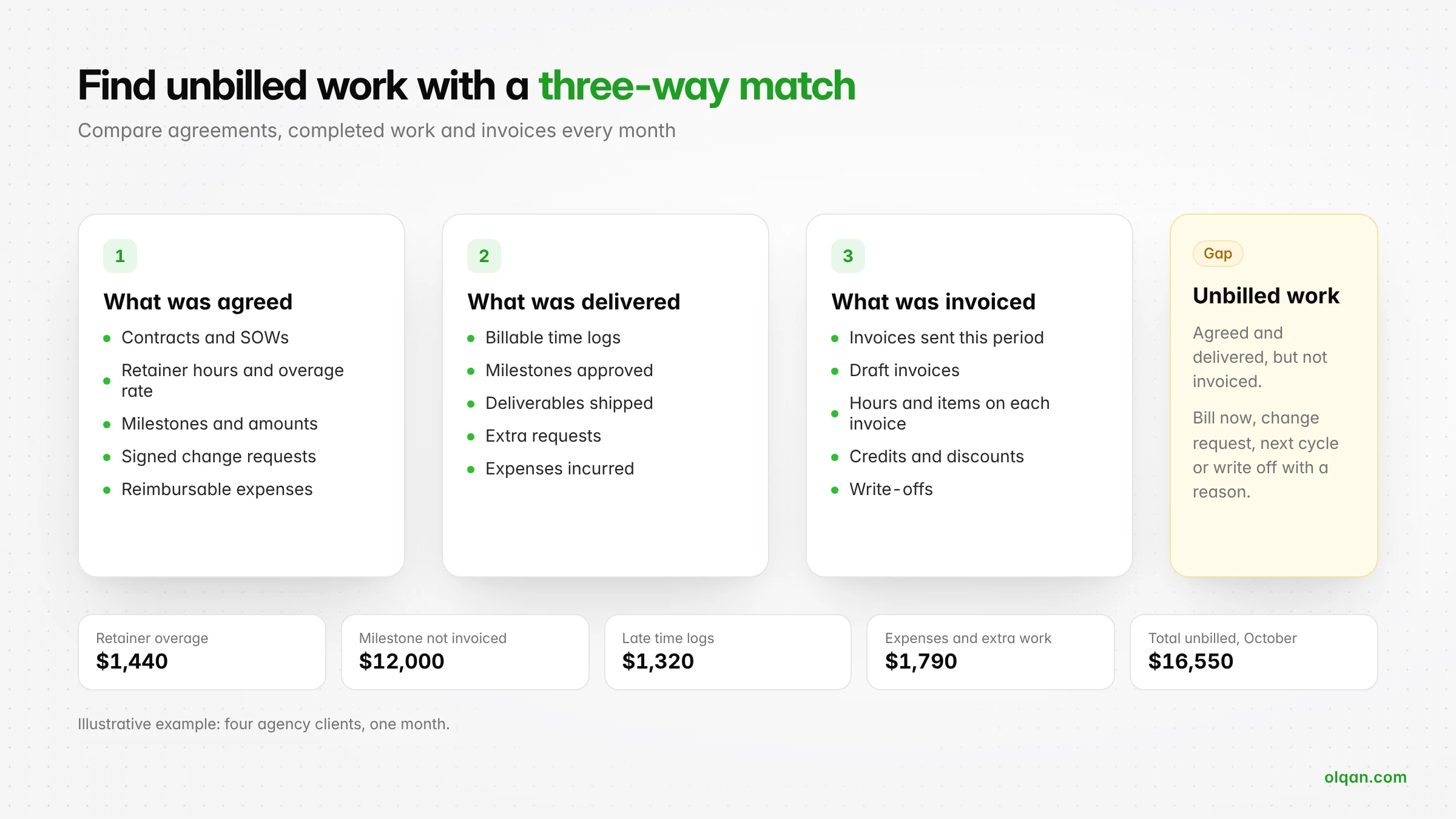
How to find unbilled work: a monthly reconciliation in six steps
- List every active agreement. For each client, note the pricing model and what is billable: hourly rates, retainer hours and overage rate, milestones and amounts, reimbursable expenses, and any change requests signed this month.
- Pull the completed work for the period. Billable time logs, milestones completed or approved, deliverables shipped and expenses incurred.
- Pull every invoice for the period, including drafts. Note what each invoice covered: which hours, which milestone, which expenses.
- Match the three lists. For each client, compare what was agreed, what was completed and what was invoiced. Every difference is a line to explain.
- Classify each gap. Bill now, raise a change request, bill next cycle (timing only), write off with a reason, or not billable under the agreement.
- Act and record. Issue the invoices, send the change requests, and log write-offs with an owner and reason so patterns show up over time.
Run it a few days before your regular invoice date, not after. The point is to catch unbilled work while it can still go on this month’s invoices.
Worked example: one month, four clients
Here is what the reconciliation looks like for a small agency in October (illustrative figures, not real clients):
| Client and agreement | Work completed | Invoiced | Unbilled | Action |
|---|---|---|---|---|
| A: retainer, $5,000 for 40 h, overage $120/h | 52 h logged | $5,000 | $1,440 (12 h overage) | Bill overage per agreement |
| B: fixed fee $40,000 website, milestone 2 = $12,000 | Design approved 18 Oct | $0 this month | $12,000 | Invoice milestone now |
| C: time and materials, $110/h | 86 billable h | 74 h = $8,140 | $1,320 (12 h) | Add to invoice, fix timesheet cut-off |
| D: campaign, expenses recharged at cost | $1,070 expenses, 6 h extra landing page variant | Fees only | $1,070 + $720 | Recharge expenses, send change request for 6 h at $120 |
| Total | $16,550 |
Two things stand out. First, $12,000 of the $16,550 is a timing problem: the milestone will be paid, but every week it waits is a week of cash flow lost. Second, the remaining $4,550 is real revenue at risk. Without the reconciliation, the retainer overage, the late hours, the expenses and the extra landing page variant would most likely never have been billed.
If $4,550 a month slips through, that is $54,600 a year of earned revenue that never reaches an invoice. To see what that does to margins, use the formulas in our guide on how to calculate agency project profitability.

Monthly unbilled work checklist
- All timesheets for the period submitted and marked billable or non-billable.
- Retainer hours used compared with hours included, for every retainer client.
- Milestones completed or approved this month matched to milestone invoices.
- Change requests signed this month added to the next invoice.
- Out-of-scope work identified and either change-requested or written off with a reason.
- Reimbursable expenses matched to client invoices.
- Draft invoices reviewed and sent, or deleted with a reason.
- Write-offs logged with an owner, amount and reason.
Metrics that show whether unbilled work is under control
| Metric | Formula | What it tells you |
|---|---|---|
| Realization rate | Hours billed ÷ billable hours logged | How much billable time actually reaches an invoice |
| Unbilled work value | Completed billable work not yet invoiced, at agreed rates | The size of your unbilled revenue right now |
| Days to invoice | Average days between work completed and invoice issued | How fast earned revenue becomes billed revenue |
| Write-off rate | Value written off ÷ billable work completed | How much work you give away, and whether it is deliberate |
| Retainer over-service | Hours used ÷ hours included | Which retainers need repricing or a scope conversation |
Track these monthly to minimize unbilled revenue and missed revenue across every revenue stream: projects, retainers and expenses. A falling realization rate or rising days to invoice is an early sign that billing is falling behind delivery.
How to reduce unbilled revenue for good
- Mark time billable when it is logged. Do not leave the decision to whoever prepares the invoice.
- Set a weekly timesheet deadline. Late time is the most common source of unbilled hours.
- Track retainer balances weekly. Share hours used with the client before the month ends, not after.
- Invoice milestones when they are approved. Make the approval the trigger, not the month end.
- Use written change requests. No extra work starts without one.
- Invoice from the same system you track work in. Spreadsheets and a separate accounting system make it hard to manage unbilled revenue. When invoices are created from time logs, milestones and retainers on the project, there is far less to reconcile by hand. See what to look for in project management software with invoicing.
Common mistakes when you track unbilled revenue
- Reconciling only invoices against payments. That finds overdue invoices, not work that was never invoiced.
- Treating every gap as a write-off. Many gaps are billable under the agreement. Check the contract first.
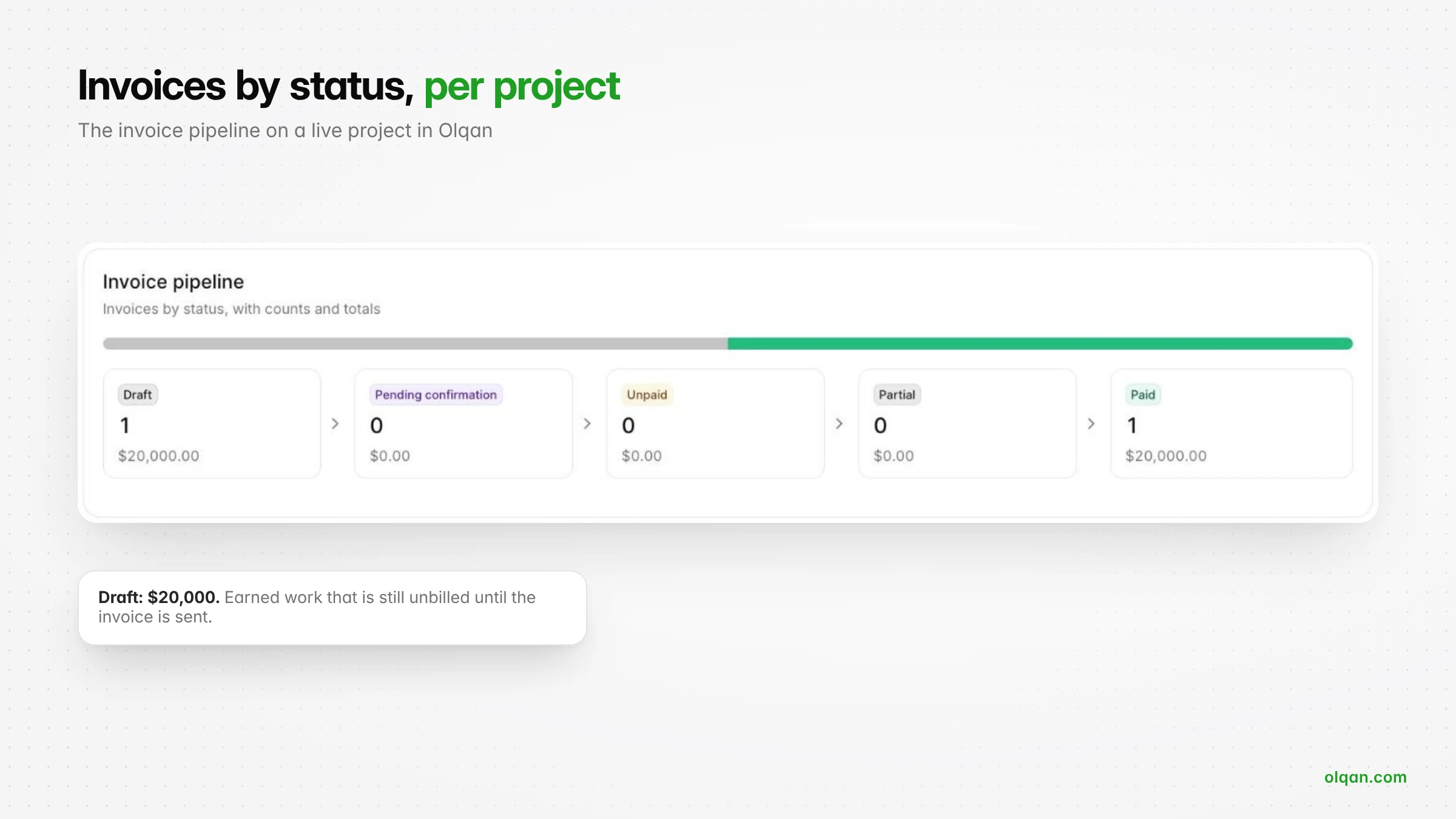
- Ignoring draft invoices. A draft is unbilled revenue until it is sent.
- Waiting until quarter end. The older unbilled work gets, the harder it is to bill without a difficult client conversation.
- No owner. If both finance and account managers think the other one is checking, nobody is.
How Olqan helps agencies bill everything they deliver
Olqan is a business operating system that helps growing service businesses, including agencies, grow profitably. Work and billing sit on the same projects, so less work falls between the cracks:
- Time tracking: the team logs time against project tasks, marked billable or non-billable.
- Invoicing from projects: create invoices from project time, milestones and retainers, plus recurring invoices for monthly work.
- Invoice pipeline: see each project’s invoices by status, from draft to paid, so drafts that were never sent stand out.
- Getting paid: payment reminders, payment tracking and reconciliation, with clients approving and paying through the Client Portal.
- Budget versus actual: hours logged against hours allocated on every project, so over-servicing is visible before month end.
Olqan offers a free Solo plan, and paid plans start at $12 per user per month billed yearly, with a 14-day trial and no credit card required (see pricing). To see it with your own clients and projects, book a demo.
Frequently asked questions
What is unbilled work?
Billable client work that has been completed but not yet invoiced, such as logged hours, approved milestones, retainer overage or reimbursable expenses.
How is unbilled revenue calculated?
Add up the value of completed billable work at the agreed rates, then subtract what has already been invoiced for that work. For hourly work, that is billable hours not yet invoiced multiplied by the rate. For milestones, it is the value of milestones earned but not yet billed.
When does unbilled revenue become accounts receivable?
When you issue the invoice. From that point, the amount is billed revenue owed by the client and sits in accounts receivable until it is paid.
What is the difference between unbilled revenue and deferred revenue?
Unbilled revenue is work done but not yet invoiced. Deferred revenue is the opposite: money invoiced or received before the work is done, such as a project deposit.
How can an agency convert unbilled revenue faster?
Invoice milestones on approval, close timesheets weekly, and reconcile before each invoice run rather than after. Reducing unbilled time between work completed and invoice issued is the quickest way to improve cash flow without winning new clients.
How often should an agency check for unbilled work?
Monthly at minimum, a few days before the regular invoice run. Agencies with many hourly or retainer clients benefit from a quick weekly check of timesheets and retainer balances.
Conclusion
Unbilled work is rarely one big mistake. It is a few hours here, an expense there and a milestone that waited a month. Compare agreements, completed work and invoices every month, classify every gap, and fix the habits that create them: late timesheets, untracked retainers and verbal scope changes. The result is not just more revenue but faster cash flow and fewer awkward conversations with clients about old work.