

A sales-to-project handoff is the moment a won deal becomes a project. For an agency, it decides whether the project starts with the scope, budget and client expectations that sales agreed, or with a forwarded email and a lot of guessing. This article gives you a practical handoff checklist, a template you can copy, a meeting agenda and a worked example, so your delivery team has everything it needs before work starts. Use it as a project handover checklist for any client engagement, from a website build to a monthly retainer.
The short answer: before a project manager accepts a new project, they need eight things in writing. Who the client stakeholders are, what was sold, how it will be billed, the budget in hours and money, the timeline and milestones, the context behind the deal, access to assets and systems, and how the client will judge success.
What is a sales-to-project handoff?
A sales-to-project handoff (also called a project handover or sales to delivery handoff) is the formal transfer of a client engagement from the sales team to the project team. Sales passes on everything it learned and promised during the sales cycle. The project manager confirms they have what they need to plan and deliver, and the client is introduced to the people who will do the work.
Some firms call it the sales operations handover or the post-sale handover. In an agency, the handoff usually has two parts:
- The internal handoff: sales and delivery meet without the client to review the deal, the scope and the risks.
- The client kickoff meeting: the project team meets the client to confirm goals, roles and responsibilities, timeline and ways of working.
Both matter. The internal handoff protects your margin. The kickoff protects the client relationship.
Why the agency handoff process fails
Most failed handoffs are not caused by bad people or bad tools. They fail because critical information lives in someone’s head, inbox or CRM notes, and the project team only finds out what was promised when the client mentions it. Typical symptoms:
- The proposal included two rounds of revisions, but the team plans for unlimited feedback.
- The deal was priced on 240 hours, but the project starts with no budget, so nobody notices when it passes 300.
- Sales spoke to the marketing director, but the project team emails a coordinator who cannot approve anything.
- A 50% deposit was agreed, but finance learns about the project at month end.
- The client was promised a launch date that the delivery team never saw.
Each one costs hours you cannot bill, and some cost client trust and confidence that is hard to win back. A good handover process makes the transition repeatable instead of relying on memory. The first weeks of delivery shape the customer experience, so a smooth transition from sales to the project team is worth the hour it takes.
The sales-to-project handoff checklist
Use this checklist for every new client project. Sales owns completing it, the project manager owns accepting it. If an item is missing, the project does not start until it is filled in.
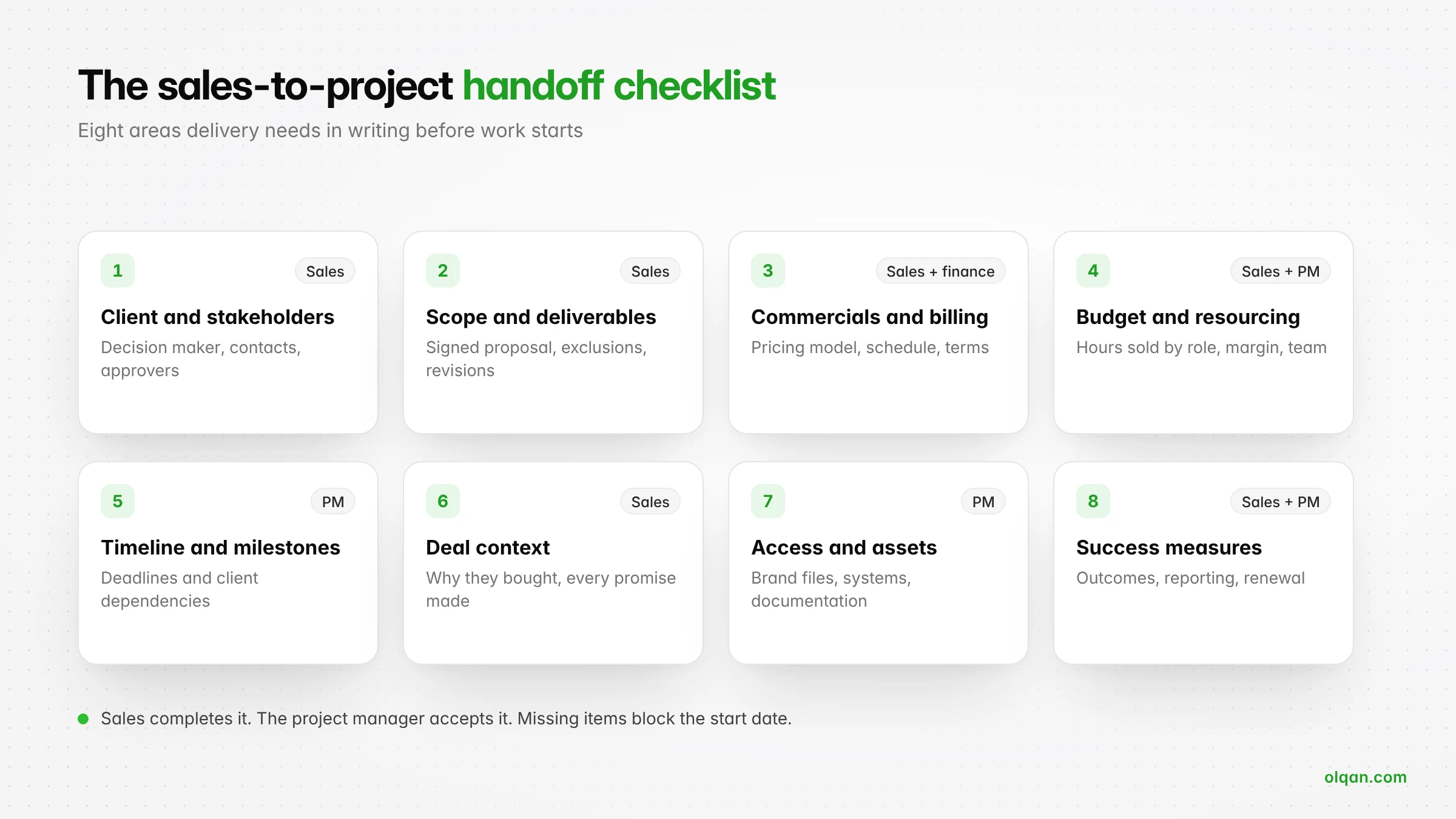
1. Client and stakeholders
- Client company name and billing entity.
- Decision maker, day-to-day contact and anyone who approves work or invoices.
- Other stakeholders who will review deliverables, and how much influence they have.
- Preferred communication channels and meeting rhythm.
2. Scope and deliverables
- The signed proposal, estimate or statement of work, not a draft version.
- Each deliverable with what is included and what is explicitly out of scope.
- Number of revision rounds and how change requests are handled.
- Acceptance criteria: how the client will sign off each deliverable.
3. Commercials and billing
- Total contract value and pricing model: fixed fee, time and materials, or retainer.
- Billing schedule: deposit, milestones or monthly, with amounts.
- Payment terms, currency, tax details and any purchase order number.
- Who receives invoices on the client side.
4. Budget and resourcing
- Hours sold, by role or phase.
- Budget in money and the target margin the deal was priced for.
- Who is staffed on the project and when they are available.
- Any freelancers or third-party costs included in the price.
5. Timeline and milestones
- Start date, key milestones and any fixed deadline (a launch, an event, a board meeting).
- Dependencies on the client: content, feedback, access, approvals.
- Dates the client cannot work, such as holidays or freeze periods.
6. Deal context and commitments
- Why the client bought, in their words, and the problem they want solved.
- Every promise made during the sales process, including informal ones.
- Concerns or objections raised before signing, and competitors they considered.
- Known risks: tight budget, unclear owner, past bad experience with an agency.
7. Access, assets and documentation
- Brand guidelines, existing assets, previous work and research.
- Access to systems the team needs: website, analytics, ad accounts, file storage.
- Links to the deal record, signed contract and call notes, in one place.
8. Success measures
- The outcomes the client expects, such as leads, launch date or conversion rate.
- How and when results will be reported.
- What would make the client renew or expand the engagement.
Project handover checklist template
Copy this template into your CRM, project management tool or a shared document. Customize the fields for your services, but keep the owner column. Clear roles and responsibilities are what make a handover checklist work.
| Item | Owner | Due | Where it lives |
|---|---|---|---|
| Client stakeholders and approvers | Sales | When the deal is won | Client record |
| Signed proposal or statement of work | Sales | When the deal is won | Deal and client record |
| In scope, out of scope and revision rounds | Sales | Before internal handoff | Project brief |
| Pricing model, billing schedule and payment terms | Sales and finance | Before internal handoff | Contract and invoice schedule |
| Hours sold by role and budget | Sales | Before internal handoff | Project budget |
| Team and availability | Project manager | At internal handoff | Project team |
| Milestones and fixed deadlines | Project manager | At internal handoff | Project plan |
| Deal context, promises and risks | Sales | At internal handoff | Project brief |
| Access and assets | Project manager | Before kickoff | Project files |
| Success measures | Sales and project manager | Confirmed at kickoff | Project brief |
One rule keeps the template honest: the project manager signs off the handoff, not sales. If the project manager cannot plan the work from what is in the checklist, it is not complete.
The handoff process: a step-by-step guide
- Get delivery involved early. For larger or unusual deals, ask a project manager to review the estimate before the proposal goes out. It is easier to fix hours before signing than after.
- Close the deal properly. After closing a deal, when it is marked won, sales attaches the signed proposal and contract and completes the checklist fields within one working day.
- Run the internal handoff. A 30 to 45 minute meeting between sales and the project team, using the agenda below.
- Set up the project. The project manager creates the project with its budget, milestones, tasks and team, and finance schedules the first invoice.
- Hold the client kickoff meeting. Introduce the team, confirm the project scope, timeline and communication plan, and outline what happens in the first two weeks.
- Check in after two weeks. Sales, the project manager and the client confirm that the project matches what was sold. Catch gaps while they are still small.
How to run the internal handoff meeting
Keep it short and structured. A 45 minute agenda that works for most agency projects:
| Time | Topic | Led by |
|---|---|---|
| 5 min | Why the client bought and what success looks like | Sales |
| 10 min | Scope walk-through: deliverables, exclusions, revision rounds | Sales |
| 10 min | Budget, hours by role, billing schedule and margin target | Sales and finance |
| 10 min | Timeline, milestones, client dependencies and risks | Project manager |
| 5 min | Promises made, stakeholder map and sensitivities | Sales |
| 5 min | Open questions, owners and kickoff date | Project manager |

Worked example: a retainer handoff
Here is what a complete handoff looks like for one deal (an illustrative example, not a real client). A 14-person agency wins a six-month content and SEO retainer:
- Client and stakeholders: Head of Marketing is the decision maker and approves invoices. A content manager is the day-to-day contact. The CEO reviews the quarterly report.
- Scope: four articles and one landing page a month, monthly SEO reporting. Paid media and website development are out of scope. One revision round per article.
- Commercials: $6,500 per month, invoiced on the first of each month, 14-day payment terms, six-month minimum.
- Budget: 60 hours a month: 32 writing, 12 SEO, 10 design, 6 account management. Priced for a 40% margin.
- Timeline: kickoff on day 3, first content plan in week 2, first articles live by week 4.
- Context: the client left their last agency because reports showed activity, not results. Sales promised a monthly report focused on leads from organic search.
- Success: organic leads tracked monthly, with a review at month three.
With this in place, the project manager sets up a retainer project with 60 hours a month, assigns the four roles and plans the first month. Finance schedules the monthly invoice. When the team has logged 48 of 60 hours by day 20, the project manager can see it in time to adjust, instead of finding out from a write-off at month end. To see how the margin on a project like this is calculated, read our guide on how to calculate agency project profitability.
Common handoff mistakes and how to prevent them
- Handing off a draft proposal. Only the signed version counts. Attach it to the deal and the project.
- No budget on the project. If hours sold are not entered as a project budget, the team cannot track budget versus actual.
- Verbal promises. Ask sales one direct question at every handoff: “What did you tell the client that is not in the proposal?”
- Sales disappears after the deal is won. Keep the salesperson in the loop until the two-week check-in, especially on new clients.
- Billing set up late. Schedule the deposit or first retainer invoice when the project is created, not when someone remembers.
- Too many tools. When the deal, the project and the invoice live in separate systems, people re-enter data and details get lost. Our comparison of CRM vs project management software explains where each fits.
How to automate the handoff process
A checklist works on paper, but it works better when the information travels with the deal. Three practical improvements:
- Make checklist fields part of the deal. Add required fields for billing model, hours sold and key contacts in your CRM, so a deal cannot be marked won without them.
- Automate the routine steps. Use workflow automation (most tools offer no-code rules) to notify the project manager and finance when a deal is won, and to create the handoff tasks.
- Keep sales and delivery records connected. The client, the signed proposal, the project budget and the invoice schedule should be linked, not copied between tools. This is what professional services automation (PSA) software and connected project management software with invoicing are designed for.
Best practices for an efficient handover
- Use a formal handoff for every project. Small projects go wrong for the same reasons as large ones. A short, well-structured handoff takes 30 minutes; a scope dispute takes days.
- Keep proper documentation in one place. Project documentation spread across email, chat and the CRM is how details get missed. Link everything to the project.
- Brief each stakeholder on their role. Make sure all parties involved, inside your internal teams and on the client side, know who approves what.
- Agree quality standards up front. Define what a finished deliverable looks like before work starts, so project outcomes are judged against the same standard.
- Plan training and support. If the client needs to use a portal or tool you provide, show them in the kickoff to drive adoption from week one.
- Measure customer satisfaction early. A short check-in after 30 days tells you whether the project team and the client see the project the same way.
- Use the same checklist for a project manager handover. If a project manager leaves mid-project, or the project team hands back to account management at project completion, the same eight areas apply.
A seamless transition is rarely luck. It is the result of the same checklist, owners and meeting used on every successful project, so your project management team never starts from a forwarded email.
How Olqan supports the sales-to-project handoff
Olqan is a business operating system that helps growing service businesses, including agencies, grow profitably. Sales, delivery and finance work from the same client record, so the handoff does not depend on copying information between tools:
- Sales Hub: leads and deals on a pipeline board, proposals and estimates from templates, and contracts that clients can e-sign.
- Sales automation and workflows: automate the routine follow-up steps around your sales process.
- Project Suite: projects for the same client with budgets, milestones, tasks, team members and timesheets, plus budget versus actual and project profitability.
- Finance Console: invoices from milestones, project time and retainers, recurring invoices and payment reminders.
- Client Portal: clients approve, sign and pay in one place.
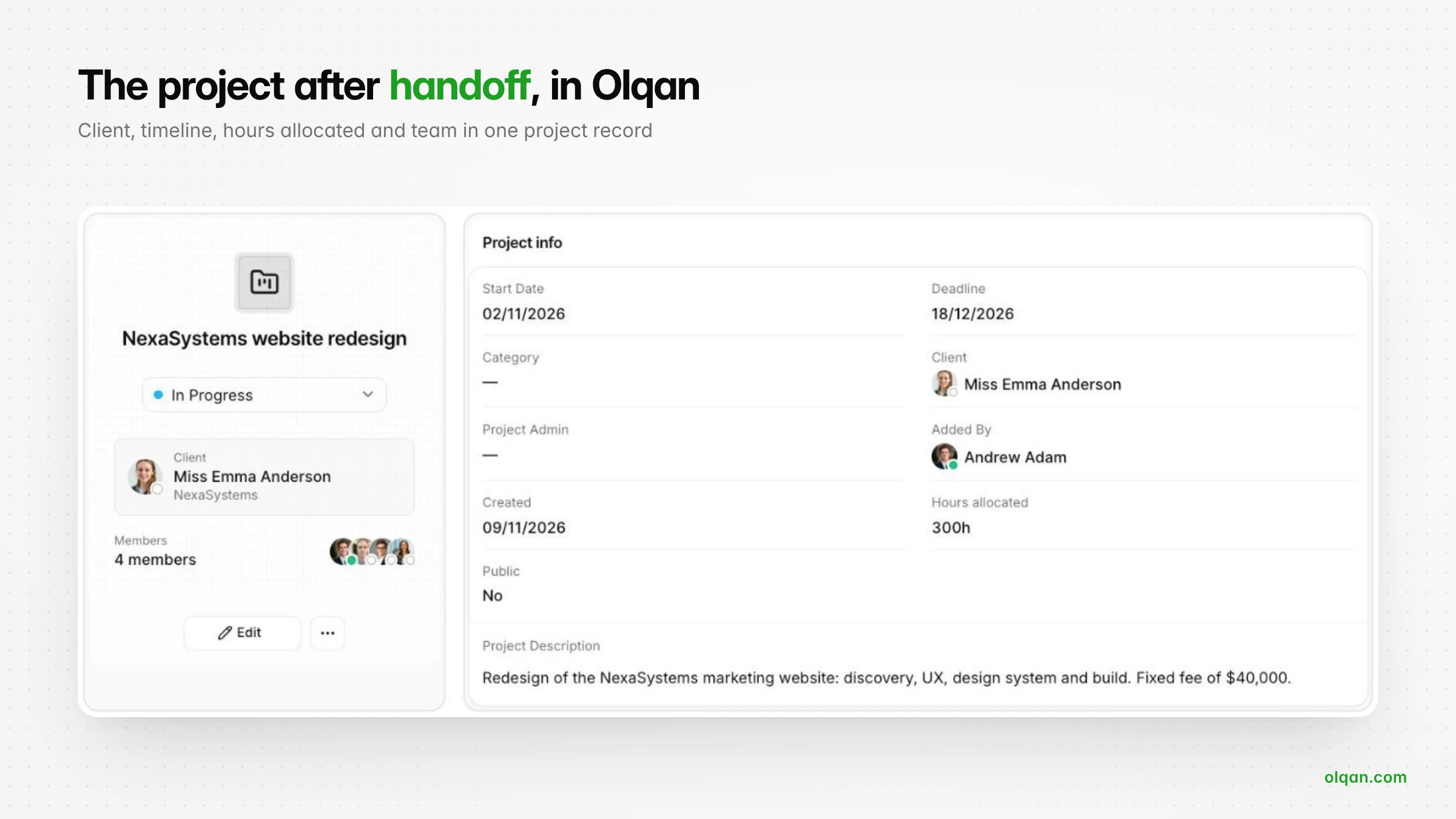
Olqan offers a free Solo plan, and paid plans start at $12 per user per month billed yearly, with a 14-day trial and no credit card required (see pricing). If you want to see your own handoff mapped in Olqan, book a demo.
Frequently asked questions
What should a sales to project handover checklist include?
At minimum: client stakeholders, the signed scope and deliverables, pricing and billing schedule, hours and budget, timeline and milestones, deal context and promises, access to assets, and success measures. Each item needs an owner.
When should the handoff happen?
Within one or two working days of the deal being won, and always before the client kickoff meeting. For complex projects, involve the project manager before the proposal is sent.
Who should take part in the handoff meeting?
The salesperson who closed the deal, the project manager, and the lead for each discipline involved, such as design, content or the development team. Include finance when billing is unusual, such as milestone billing in several currencies.
What is the difference between a handoff and a kickoff meeting?
The handoff is internal: sales briefs the project team. The kickoff meeting includes the client and confirms goals, scope, timeline and communication plan with them.
Is a handover checklist template enough on its own?
It is a good start. It works best when the checklist lives where the deal and project live, so nothing has to be copied and the project manager can see what was sold at any time.
Conclusion
A sales-to-project handoff is where agencies protect their margin and their client relationships. Use the checklist for every project, make the project manager responsible for accepting it, run a short internal handoff before the kickoff meeting, and check in after two weeks. When the deal, the project and the invoice share the same data, the handoff becomes a routine step instead of a risk.